
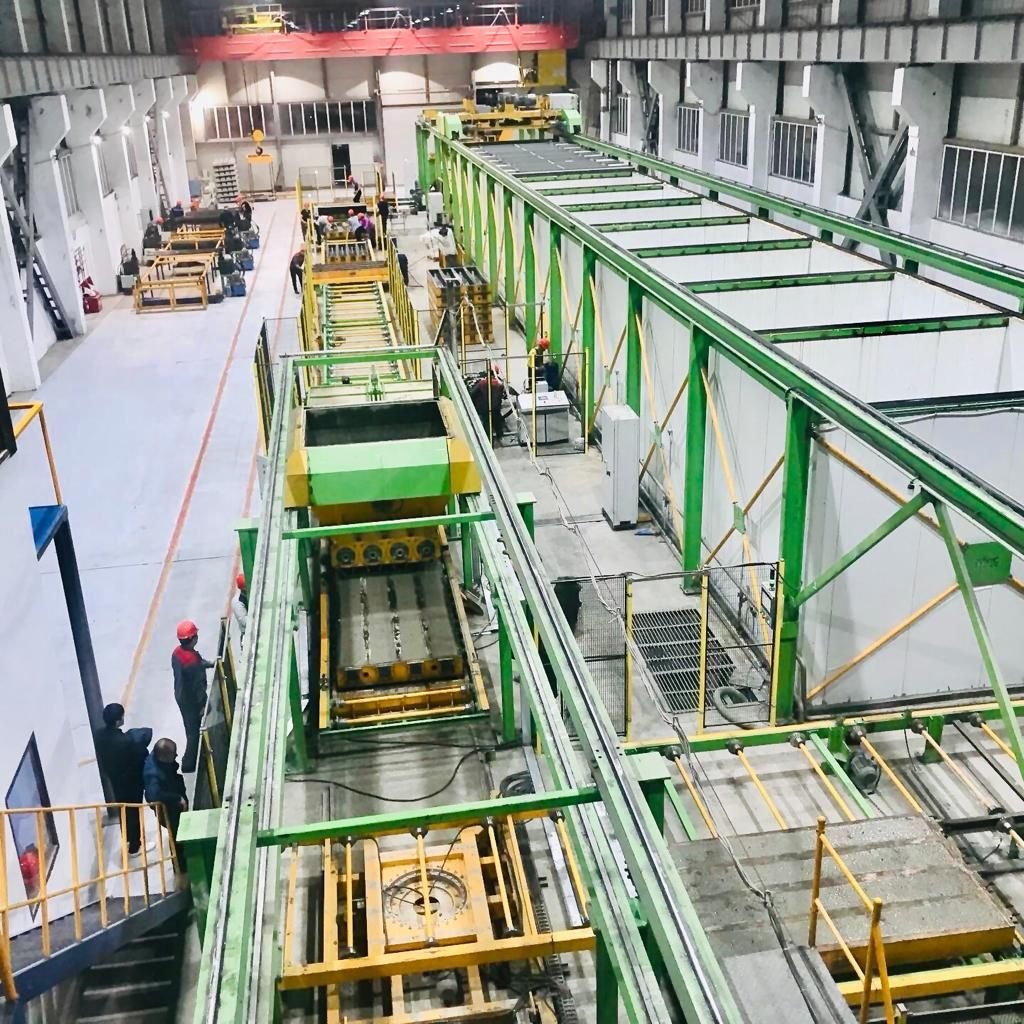
Carrousel concrete sleeper production plant
A carrousel plant moves sleeper moulds through fixed stations for cleaning, tensioning, concreting, curing and demoulding. It suits high-volume prestressed sleeper production, and different sleeper types can run on the same line.
- Production method
- Carrousel, moving moulds
- Sleepers per mould
- 4 (typical)
- Designed to
- EN, AREMA, GOST
- Prestressing
- Pre-tensioned threaded bars
- Capacity
- Defined per project
How a carrousel plant works
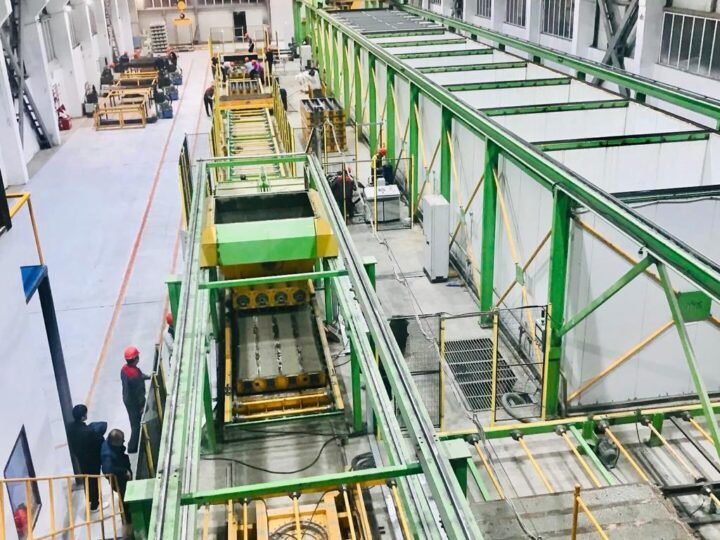
In a carrousel plant the moulds travel and the workstations stay in place. Sleeper moulds circulate on conveyors through a fixed sequence: mould cleaning and oiling, placing and tensioning the prestressing bars, concreting and vibration, curing in a heated chamber, de-tensioning, and finally lifting and turning the mould to release the finished sleepers.
Each mould typically holds four sleepers. Prestressing bars with threaded ends are anchored at one end with a tie bolt spindle and tensioned at the other with a tensioning spindle, then locked with nuts that bear on the mould. Ribbed or profiled bars give a firm bond between steel and concrete and a good transfer of force.
Why buyers choose a carrousel line
- Flexibility. Several sleeper types and sizes can be produced with different moulds, even within the same shift.
- Short bars, easy traceability. Prestressing bars are around 2.6 m long, far easier to handle and trace than the long strands of a long-line bed.
- Compact footprint. The line fits in a shorter hall than a long-line plant.
- No saw cutting. Sleepers are cast individually, so there is no cutting dust or wastewater to treat.
- Consistent quality. A high degree of automation keeps dimensions and strength uniform.
Built to your sleeper design
Sleeper designs differ by country and use. Moulds are designed in 3D from the sleeper drawing you supply and to the applicable standard, such as EN, GOST or AREMA.
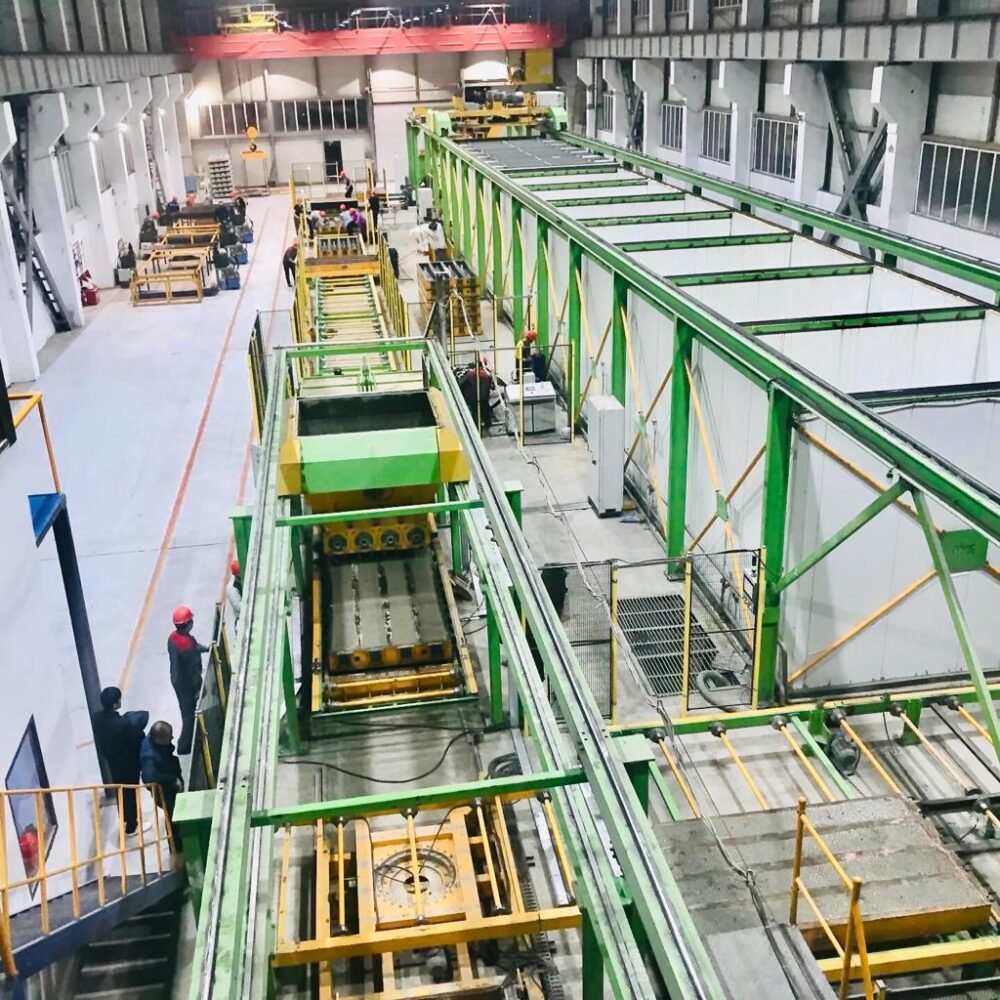
From empty mould to finished sleeper
Mould cleaning and oiling
Returning moulds are cleaned and coated with release agent.
Bar placement and tensioning
Prestressing bars are placed and tensioned at the tensioning station, one cavity at a time.
Concreting and vibration
Concrete is placed and the mould passes a vibration station for full compaction.
Curing
Moulds move into curing chambers, where heat shortens the hardening time.
De-tensioning
When the concrete reaches the required strength, the bars are released and the force transfers into the sleeper.
Demoulding and stacking
The mould is lifted and turned over to release the sleepers, which are then checked and stacked.
Main machines and systems
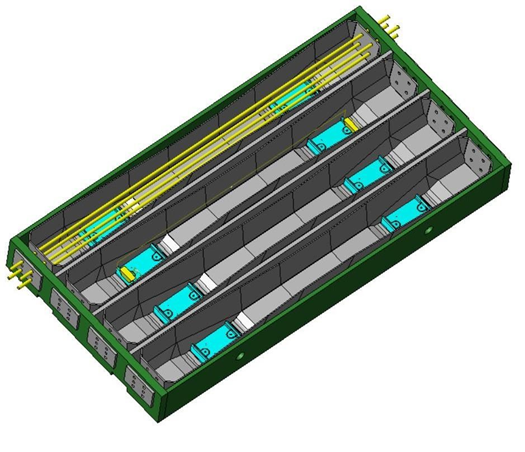
Sleeper moulds
Steel moulds designed from your sleeper drawing and standard. Two to four sleepers per mould are possible; four is typical.
- Sleepers per mould
- 4 (typical)
- Standards
- EN, AREMA, GOST
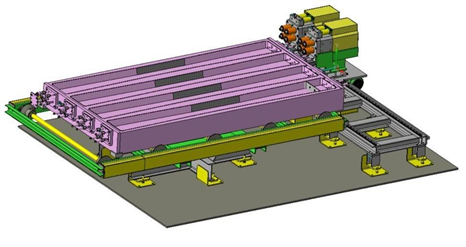
Tensioning machine and station
Tensions the bars through the tie rods at the required force, one cavity at a time, with four tensioning cylinders working together. The force is set to the applicable standard.
- Stressing force
- max. 460 kN at 370 bar
- Stressing stroke
- 80 mm
- Pump unit
- 8.4 l/min, 5.5 kW, PLC
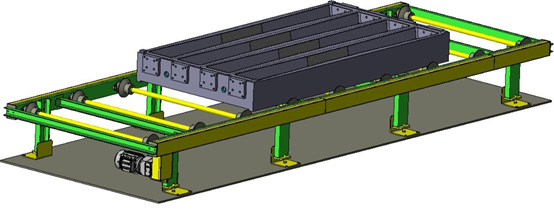
Mould transfer conveyors
Roller conveyors, 90 degree rotary roller conveyors and movable rotary conveyors move moulds automatically or semi-automatically between stations.
- Drive power
- 2.2 kW
- Drive speed
- 0 to 0.4 m/s, variable
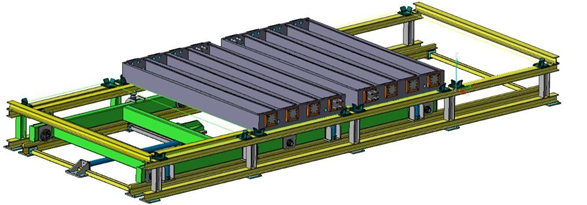
Hydraulic transfer systems
Hydraulic lifting and moving conveyors take moulds out of the curing chambers to the relaxing station step by step, lifting moulds or traverses with hydraulic pistons.
Specifications
Typical values from manufacturer documentation. Final figures are confirmed in the manufacturer's offer for your project.
| Mould width | 1,500 mm |
|---|---|
| Sleepers per mould | 4 |
| Manipulator lifting capacity | 6,000 kg |
| Longitudinal travel | 50,500 mm |
| Transversal travel | 4,000 mm |
| Lifting height | 4,000 mm |
| Positioning accuracy | ±1.5 mm |
| Travel speed, longitudinal | 0 to 1.0 m/s |
| Travel speed, transversal | 0 to 0.3 m/s |
| Lifting speed | 0 to 0.5 m/s |
| Lifting power | 30 kW |
| Drive motors | 2 × 5.5 kW |
| Tensioning force | max. 460 kN at 370 bar |
| Conveyor drive | 2.2 kW, 0 to 0.4 m/s |
Example values from one manufacturer configuration (mould handling manipulator, tensioning and conveyor units). Plant capacity and layout are defined for each project.
Built for these buyers
Precast producers
Companies adding railway sleepers to their product range.
Rail infrastructure contractors
Contractors setting up local sleeper production for a corridor project.
Railway project owners
Owners and their contractors who need sleepers produced close to the line.
Existing sleeper plants
Producers moving from long-line to a more automated, flexible line.
Questions buyers ask
Carrousel or long-line: which one do I need?
A carrousel line suits high volumes, several sleeper types and a shorter hall. A long-line plant needs a longer hall and more manual work, and often suits smaller operations with uniform products and a lower investment. Our guide compares both in detail.
Can the plant produce our sleeper design?
Moulds are designed from the sleeper drawing you supply and to the applicable standard, such as EN, AREMA or GOST. Send the drawing with your RFQ.
How is payment secured?
Payment terms are set in the contract with the manufacturer, typically an advance payment or a letter of credit.
Who installs the plant?
Installation and commissioning are carried out by the manufacturer. VDA coordinates the schedule between you and the manufacturer.
How are lead times confirmed?
Production and delivery times depend on the plant scope and the manufacturer's schedule. They are stated in the offer and fixed in the contract.
Related machinery
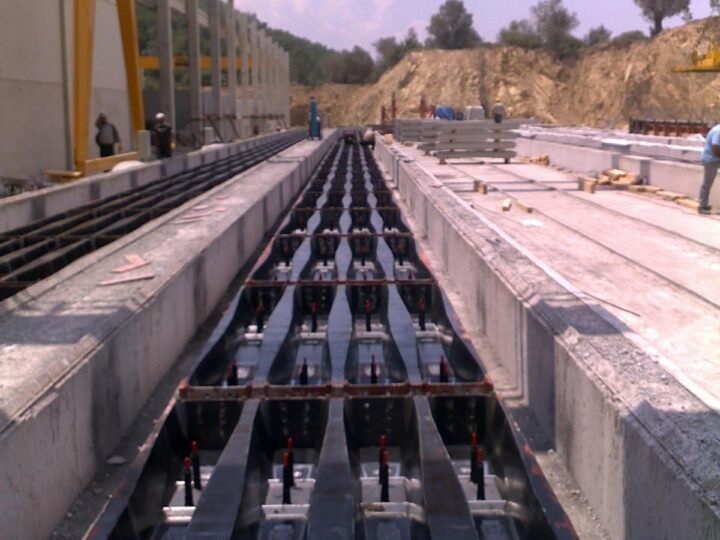
Long-line Concrete Sleeper Plant
Long prestressing beds where sleepers are cast in a continuous line and saw cut after curing. A lower-investment route for uniform sleeper…
View details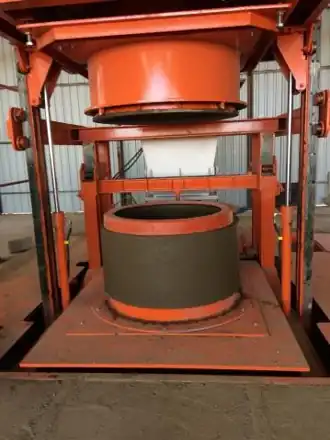
Elevator System Manhole Ring & Cone Machine
Elevator system machine for manhole rings Ø800 to Ø1500 mm and cones up to Ø1500/620 mm, for sewer, stormwater, telecom and hydrant…
View details
Crane System Manhole Base Machine
Crane system machine for manhole bases Ø800 to Ø1500 mm and 2000×2000 mm, with inlet and outlet openings from Ø150 to Ø1200…
View detailsRead before you buy
Long-line vs carrousel sleeper production: which method fits your project?
How long-line and carrousel sleeper plants compare on space, flexibility, bar handling, concrete quality, output and environmental impact.
Carousel Concrete Sleeper Manufacturing Plants
What sleepers do in a railway track, how a carousel sleeper plant produces them step by step, and why the method suits high-volume production.
Get offers for Carrousel Concrete Sleeper Plant
- Tell us the product, capacity and project country.
- We clarify the technical scope with you.
- You receive offers from suitable manufacturers to compare.
- Prefer WhatsApp? +90 543 797 58 57