Key takeaways
- A compact plant uses the same pretensioned process as a large sleeper factory, with fewer moulds and crane handling instead of automation.
- It fits mining railways that need a sleeper nobody stocks, such as a narrow gauge, a light rail or a low axle load, at a site far from any sleeper producer.
- Our Zambia mining railway reference produces 40 sleepers per day from 10 moulds with 4 sleepers each, one gantry crane, 4 workers and one 8-hour shift.
- In a hot climate, that line was configured without a heated curing chamber or a batching plant. Concrete comes from a mixer.
- The buyer gives the sleeper dimensions and track data; the manufacturer designs the sleeper and the buyer approves the design.
- Size the plant from your track programme: kilometres per year × sleepers per kilometre ÷ working days.
Yes. A compact concrete sleeper plant is a small carrousel line, typically about ten steel moulds, a gantry crane and a few fixed stations, that a mine or rail contractor can run near its own railway. It produces prestressed concrete sleepers to the line’s own gauge, rail and axle load, in tens per day, with a small crew and simple concrete supply.
What is a compact concrete sleeper plant?
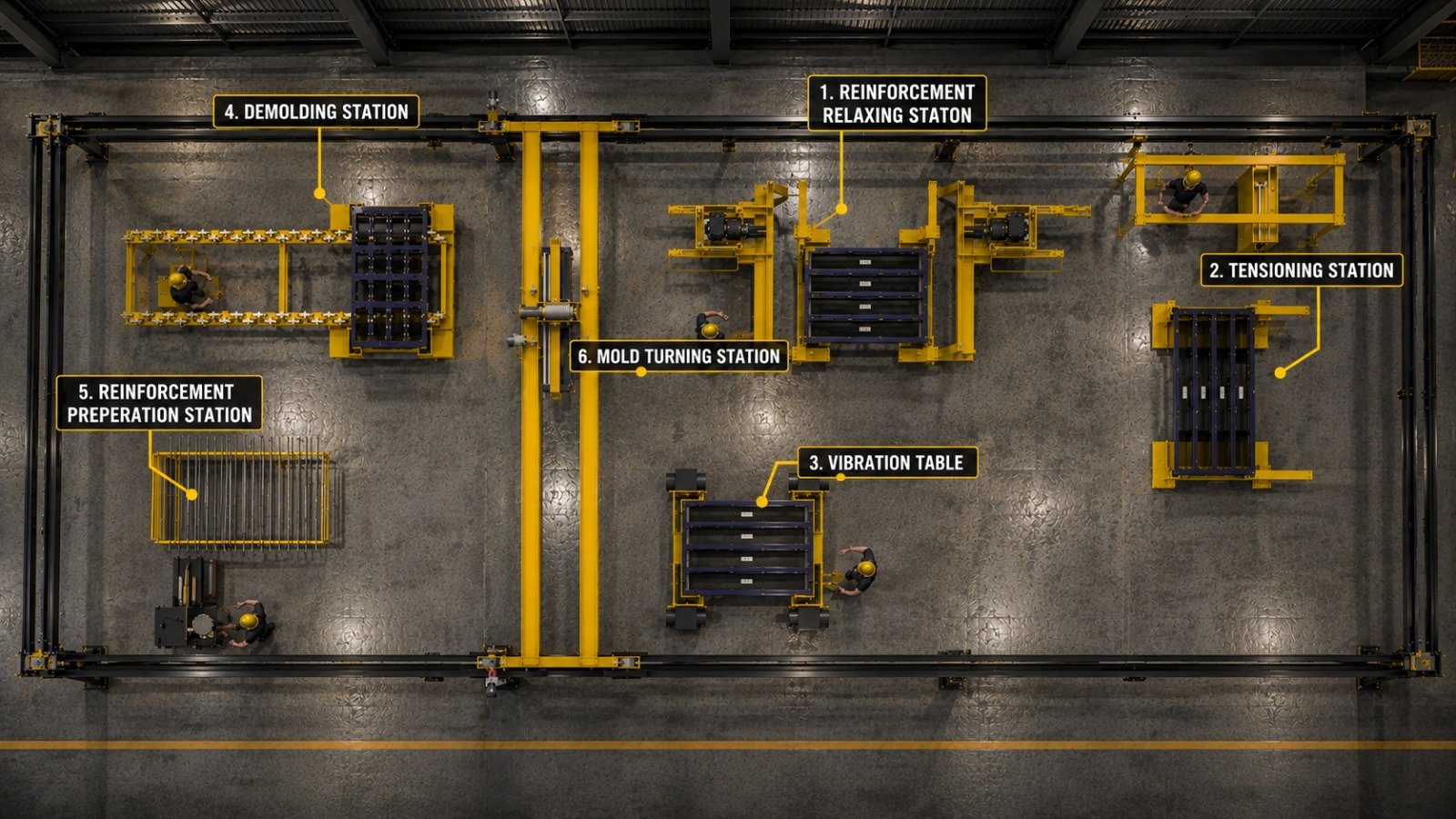
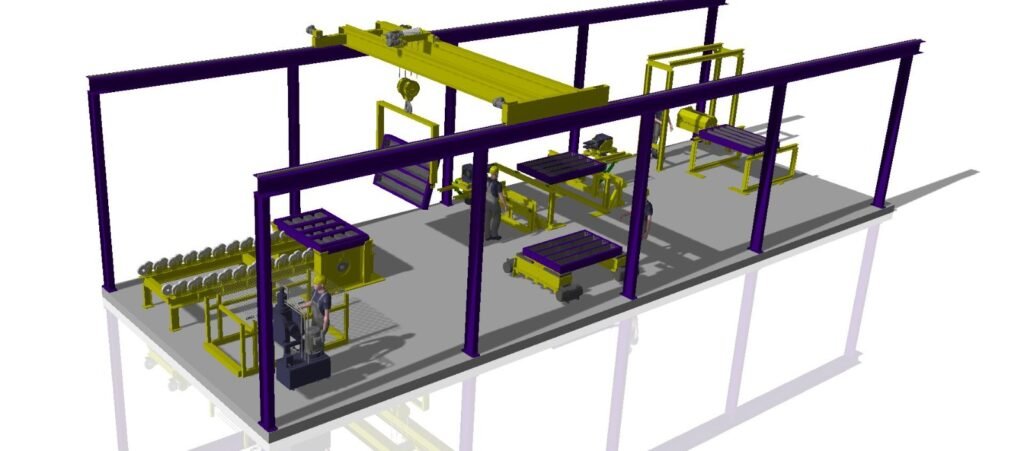
A compact sleeper plant is a carrousel production line sized for low daily output. Steel moulds, each holding several sleepers, move between fixed workstations. Each station does one job.
| Station | What happens there |
|---|---|
| Reinforcement preparation | Prestressing wire is cut to length and the ends are button-headed so they lock into anchor plates |
| Tensioning | The wires are pulled to the design force through tie rods and locked against the mould |
| Vibration table | Concrete is placed in the mould and compacted by vibration to remove air voids |
| Hardening area | Filled moulds wait until the concrete reaches the strength needed to release the prestress |
| Detensioning | The prestress is released at both ends at the same time, transferring the force into the concrete |
| Mould turning | The mould is rotated 180° |
| Demoulding | Sleepers are released onto a roller conveyor and taken to the stockyard |
One gantry crane moves the moulds between stations. The line needs no powered transfer cars or automated conveyors between stations. Compared with a large plant, the method is the same; what changes is the number of moulds, the level of automation and the size of each station. For the production methods themselves, see long-line vs carrousel sleeper production and carousel sleeper plants. For the equipment itself, see our compact concrete sleeper plant page.
Can a mining company produce its own railway sleepers on site?
Yes, and for many mine lines it is the most practical option. Three conditions point to on-site production:
- The sleeper is non-standard. Mine railways often use a narrower gauge, a lighter rail or a lower axle load than the national network. Zambia’s national network, for example, uses 1,067 mm Cape gauge (Zambia Railways). A 914 mm mine line beside it needs its own sleeper, and very few producers keep one in stock.
- The site is remote. Finished sleepers are heavy and can be damaged in transport. Producing near the line means mainly cement, aggregate, prestressing wire and fastening parts have to travel.
- Track work continues for years. Mines extend sidings, open new pits and replace track. A small plant on site can keep supplying sleepers instead of the mine placing repeated import orders.
What does a 40-sleepers-per-day plant look like? The Zambia example
VDA supplied a concrete sleeper production line for a railway in a mining area of Zambia, for a South Africa-based buyer. The layout below shows the type of line proposed.
The buyer’s request was short and complete:
| Parameter | Buyer’s requirement |
|---|---|
| Track gauge | 914 mm |
| Rail | 40 kg/m |
| Axle load | 10 tonnes |
| Sleeper dimensions | 1,625 mm long × 200 mm wide × 140 mm high |
| Fastening | 4 cast-in shoulders per sleeper, with compatible elastic spring clips (e-clip type or equivalent) |
| Daily output | 40 sleepers |
VDA proposed a compact carrousel plant and coordinated the project with the manufacturer. The configuration offered:
| Item | Configuration |
|---|---|
| Moulds | 10 steel moulds, 4 sleepers per mould |
| Output | 40 sleepers per day: each mould is cast once a day |
| Mould handling | 1 gantry crane |
| Concrete supply | Concrete mixer, no batching plant |
| Curing | No heated curing chamber. Concrete hardens at ambient temperature in a hot climate |
| Crew | 4 workers |
| Shift | One 8-hour shift |
The configuration is simple because the sleeper is small. A 1,625 × 200 × 140 mm sleeper fits within about 0.046 m³. Light moulds, a single crane and a mixer are enough for that volume.
Two points from this specification apply to any similar project:
- The fastening is built into the mould. Cast-in shoulders are steel inserts placed in the mould before casting. They anchor the rail clips and fix the rail position. Choose the shoulder and the clip together, because the mould sets where the shoulders sit.
- The output follows from the mould count. With one casting per mould per day, daily output equals moulds × sleepers per mould. To raise output later, add moulds and check that the other stations have spare cycle time.
What should a mining company specify before asking for quotes?
Fix the track data and the daily output first. The manufacturer designs the mould from the sleeper, and the sleeper from the track data. Without these inputs, quotes cannot be compared like for like.
| Item | Why it matters |
|---|---|
| Track gauge | Sets the rail seat positions |
| Rail section (kg/m) | Sets the rail seat width and the fastening |
| Axle load and train speed | Set the design loads, and with them the prestressing wire and force |
| Sleeper dimensions (L × W × H) or drawing | Define the mould cavity |
| Fastening system | Type and number of shoulders cast into each sleeper |
| Design standard | EN 13230, AREMA or a national or owner specification. Decides the approval tests |
| Daily output and shifts | Set the number of moulds |
| Climate | Decides whether heated curing is needed |
| Concrete supply | Mixer on site, existing batching plant or ready-mix |
| Shelter | Open site, roofed structure or hall |
Who designs the sleeper, and which standard applies?
In our Zambia project, the buyer gave the sleeper dimensions, the manufacturer designed the sleeper and submitted the design for the buyer’s approval, and approving the design was the buyer’s responsibility. This split is common, and it should be written into the contract.
A narrow-gauge sleeper can be designed and tested to the same standard family as a mainline sleeper. The European series is EN 13230: Part 1 covers general requirements and Part 2 prestressed monoblock sleepers (EN 13230-1 preview, iTeh). The standard leaves some values for the purchaser to set, including the minimum concrete strength class. Railway owners set them in their own specifications. Bane NOR in Norway and Rail Baltica both require at least C50/60 concrete. Rail Baltica also requires static, dynamic and fatigue design-approval tests to EN 13230-1/-2 in an ISO/IEC 17025-accredited laboratory (Bane NOR, Rail Baltica).
For a private mine railway, the owner or its track engineer chooses the standard. Agree on it before the mould is made, because it decides how the first sleepers will be tested.
Do you need a curing chamber in a hot climate?
Not always. In the Zambia configuration, the concrete hardens at ambient temperature and each mould is cast once a day, so the line needs no heated curing chamber. Heated curing mainly shortens the time to release, which matters when moulds must be reused several times a day or the climate is cold.
Two things still need care without a chamber:
- Release strength. The prestress is released only when test cubes cast from the same concrete reach the strength set in the sleeper design. Releasing too early can damage the bond between wire and concrete at the sleeper ends.
- Hot-weather concreting. High temperatures, sun and wind can dry fresh concrete too fast. Shade the work area, keep fresh concrete covered and plan casting times. ACI 305R, the Guide to Hot Weather Concreting, covers these practices (ACI).
Do you need a concrete batching plant?
Not at this scale. At 40 small sleepers a day, the daily concrete volume is low enough for a mixer on site, and that is how the Zambia line was configured. What matters is consistency: weigh the cement, aggregate, water and admixture for every batch, use clean, graded aggregate, and cast test cubes from each production day. A batching plant becomes worth considering when output, or the number of moulds cast per day, grows.
How many workers does a small sleeper plant need?
The Zambia configuration runs with 4 workers on one 8-hour shift. The crew cleans and oils the moulds, sets the shoulders and wires, tensions, casts, detensions and demoulds. The gantry crane moves the moulds between them. Add a person responsible for concrete quality and cube testing, whether that person comes from the plant crew or the mine’s own laboratory.
How many sleepers per day does a mining railway need?
Work backwards from the track programme. Sleepers per kilometre = 1,000 ÷ sleeper spacing in metres. At 650 mm spacing, that is about 1,540 sleepers per km.
| Daily output | Sleepers per year (300 days) | Track per year at 650 mm spacing |
|---|---|---|
| 40 | 12,000 | ≈ 7.8 km |
| 80 | 24,000 | ≈ 15.6 km |
| 120 | 36,000 | ≈ 23.4 km |
Illustrative arithmetic. Use your own sleeper spacing, working days and spares allowance.
When is a compact plant the wrong choice?
When the project needs hundreds of sleepers a day for a mainline or a heavy-haul railway. At that scale, a fully equipped carrousel or long-line plant with a batching plant and controlled curing is the usual answer. A compact plant is also unnecessary if a producer nearby already makes your sleeper at an acceptable delivered cost. Browse the sleeper plant catalogue for both compact and high-capacity options.
What this means for mining companies in Africa
Many new and refurbished railways in Africa are built for mines: to move ore to a mainline, a processing plant or a port. These lines often have their own gauge and axle load, and they run far from sleeper factories. A compact plant lets the owner make sleepers to its own specification next to the line, with local cement and aggregate, a small crew and simple equipment. Before ordering, check three things: a reliable cement supply that meets the mix design, a person who will own concrete quality, and the site layout for moulds, stockyard and loading.
How VDA can help
VDA turns your track data into a clear technical scope, matches it with the right Turkish manufacturer, and coordinates design approval, contract, production, shipment and installation. We did this for the Zambia mining railway project. Send your gauge, rail, axle load, sleeper dimensions and daily output through our request for quotation form or message us on WhatsApp (+90 543 797 58 57).
Sources
Frequently asked questions
Can concrete sleepers be used on a narrow-gauge mining railway?
Yes. Prestressed concrete sleepers can be designed for any gauge, rail section and axle load. The mould is made for that sleeper, and the design is tested to an agreed standard such as EN 13230.
What is the smallest practical concrete sleeper plant?
It depends on the sleeper and the daily target. Our Zambia reference makes 40 sleepers a day with 10 four-sleeper moulds, one gantry crane and 4 workers on one shift.
What is a cast-in shoulder?
A steel insert set into the sleeper during casting. It anchors the elastic rail clip and holds the rail in place, so its type must match the clip and the rail.
Can a compact sleeper plant be expanded later?
Usually yes, by adding moulds, adding a shift or adding curing capacity, as long as the stations have spare cycle time. Ask the manufacturer to state each station's limit in the offer.
Who is responsible for the sleeper design?
It should be agreed in the contract. In our Zambia project, the manufacturer designed the sleeper from the buyer's dimensions and the buyer approved it.