Key takeaways
- In a carousel plant, the moulds travel; in a long-line plant, the beds stay and the work moves along them.
- Carousel lines can change sleeper type by changing moulds, even within a shift; changing type on a long-line bed takes downtime.
- Carousel strands are cut to mould length and tensioned per mould; long-line strands run the full length of the bed and are cut after curing.
- Long-line production needs saw cutting, with dust and slurry to manage; carousel casting has no cutting.
- Daily output of either system depends on the number of moulds or beds, the curing cycle and the shifts worked, so it is set for each project.
A carousel plant moves the moulds through fixed stations and suits buyers who want automation, several sleeper types and a compact hall. A long-line plant casts sleepers on long prestressing beds and suits steady production of one sleeper type with a lower machinery investment. The right choice depends on your annual volume, the number of sleeper types, the hall you have and the labour you can employ.
The comparison in one table
| Factor | Carousel plant | Long-line plant |
|---|---|---|
| Principle | Moulds circulate through fixed stations | Sleepers cast in a row on long prestressing beds |
| Hall | Stations arranged in a loop; usually a shorter hall | A long, straight hall for the full length of the beds |
| Machinery investment | Higher | Lower |
| Automation and labour | High automation, fewer operators per shift | More manual work: placing, finishing, cutting |
| Several sleeper types | Yes, with different moulds | Possible, but changing type stops the bed |
| Prestressing | Strands cut to mould length and tensioned per mould | Strands run the full length of the bed |
| Cutting after curing | Not needed | Saw cutting into single sleepers |
| Dust and wastewater | Low | Cutting dust and slurry to treat |
| Best fit | Large or varied production, national rail programmes | Smaller, uniform production, lower budget |
How each system works
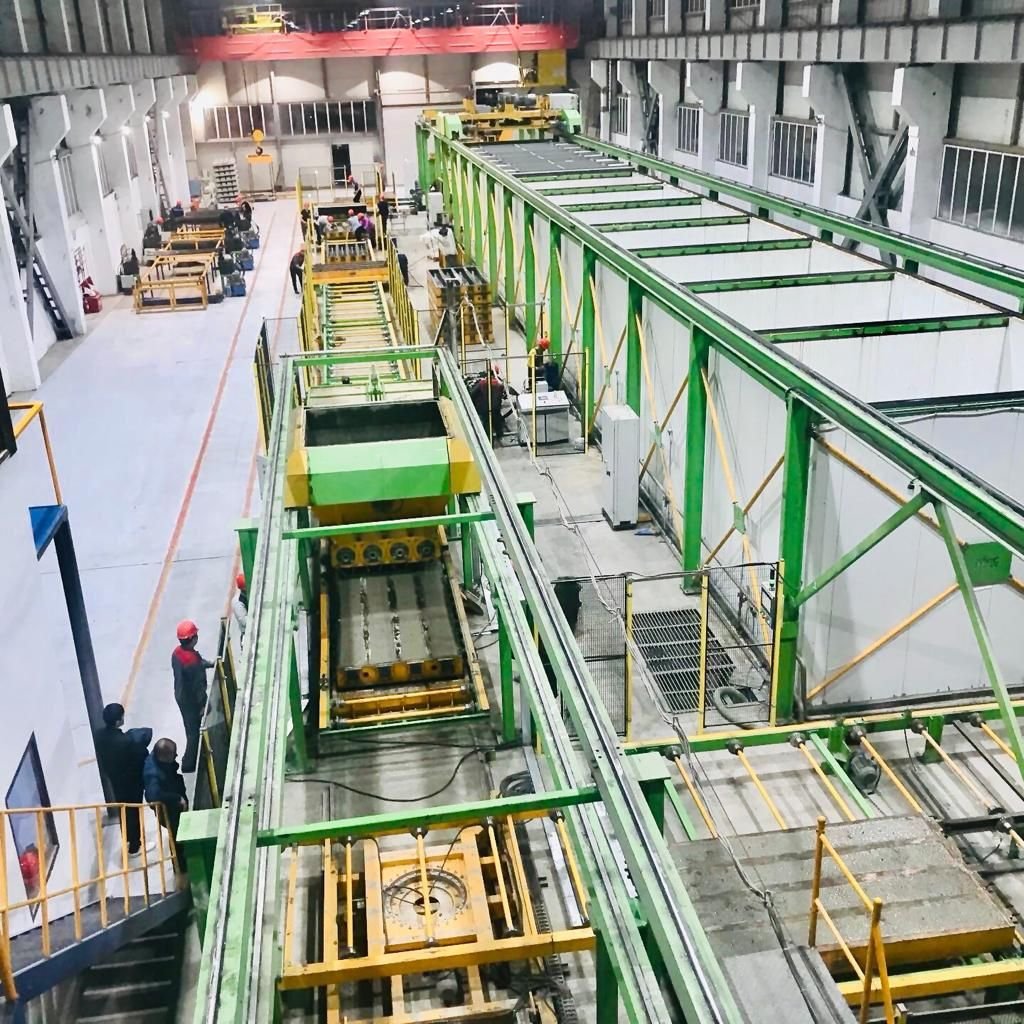
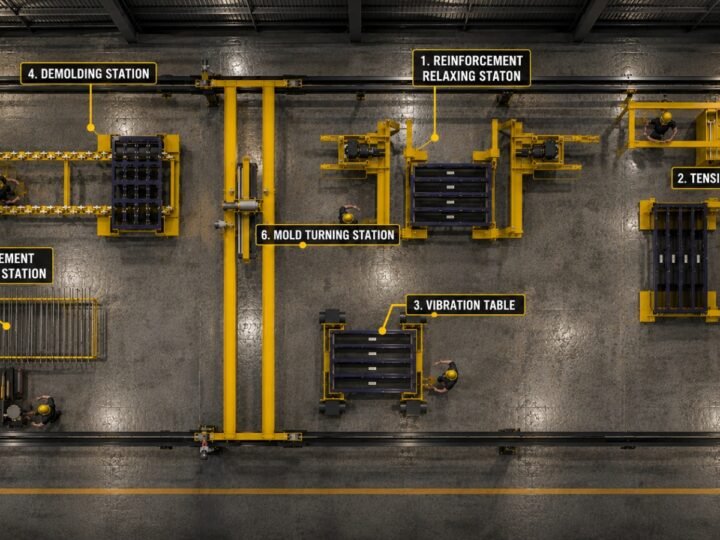
In a carousel plant, each mould is a self-contained production unit. It travels on conveyors or transfer cars through a fixed sequence: cleaning and oiling, placing of dowels and strands, tensioning, concrete casting and compaction, curing, detensioning and demoulding. After demoulding, the empty mould returns to the start of the loop. Machines do the repetitive work at each station.
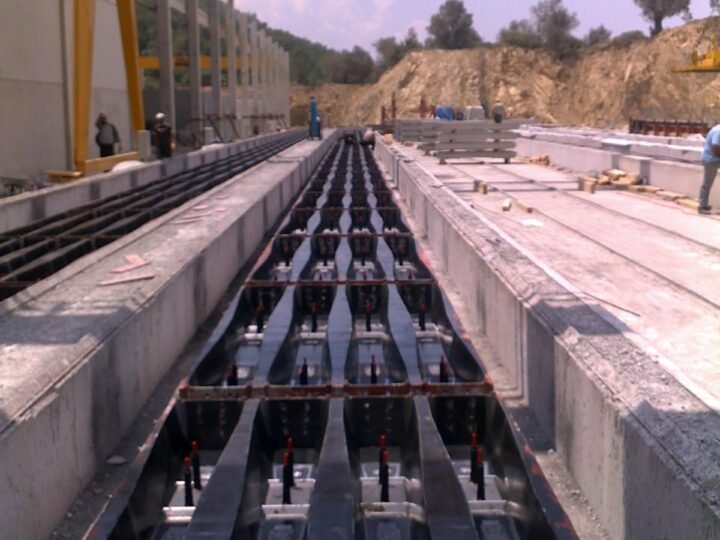
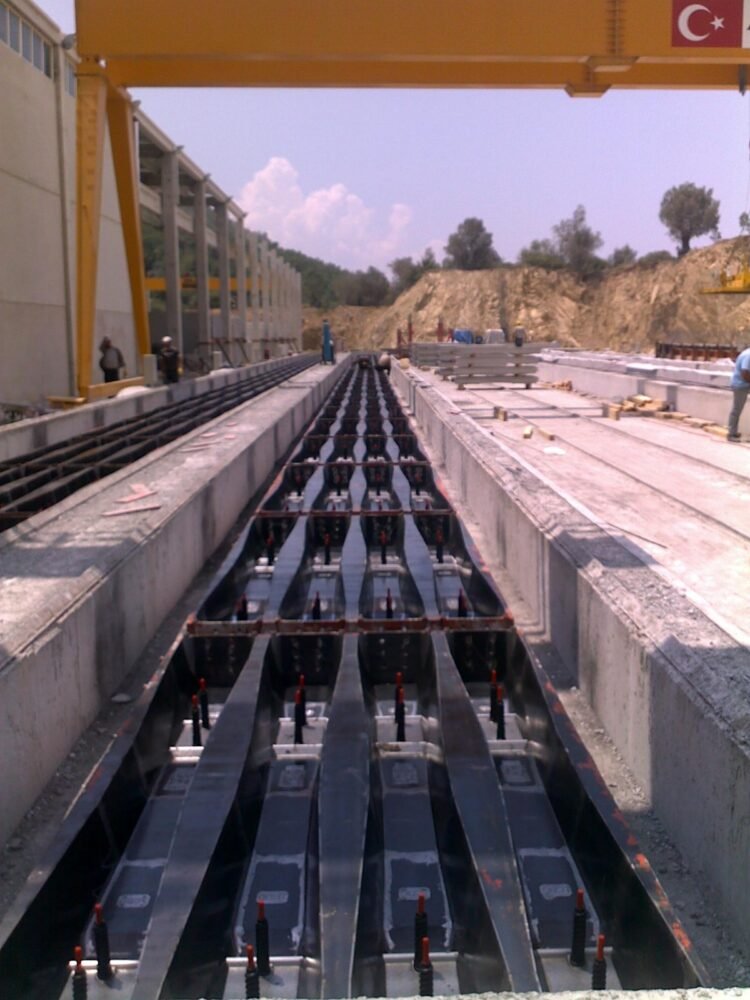
In a long-line plant, steel moulds for many sleepers are set end to end on prestressing beds. Strands are pulled the full length of the bed and tensioned at the abutments. A casting machine fills the moulds along the bed, the line cures, the strands are released and a saw cuts the line into single sleepers.
Hall size and layout
A long-line plant needs a long, straight hall to hold its beds, plus space for the saw, stockyard and handling. A carousel plant arranges its stations in a loop and usually fits a shorter hall. If you are adapting an existing building, its length and crane capacity will often decide the system before anything else.
Investment and labour
A long-line plant needs less machinery and is usually the lower initial investment. It uses more people per shift for placing, finishing, detensioning and cutting.
A carousel plant has more mechanical equipment: mould conveyors, tensioning and detensioning stations, a casting station, curing chambers and a demoulding unit. The investment is higher, but fewer operators run the line and each step is repeated the same way for every mould. Where skilled labour is scarce or expensive, this weighs heavily in the decision.
Flexibility in production
Rail networks rarely use one sleeper. Main lines, sidings, turnouts, different gauges and fastening systems all need different designs. A carousel plant can run different moulds in the same loop, so several sleeper types can be produced in one shift. A long-line bed is set for one type; changing it means stopping the bed and changing moulds along its full length.
Turnout sleepers are longer and vary in length along the switch. They are usually made on a dedicated turnout sleeper line rather than in a standard carousel or long-line plant.
Prestressing and strand handling
In a carousel plant, strands are cut to the length of the mould and tensioned in each mould. Short strands are easier to handle, inspect and trace to each sleeper.
In a long-line plant, strands run the full length of the bed. Tensioning long strands needs strong abutments, careful safety zones around the bed and good control of strand position along the line.
Concrete placing and quality
Both systems can produce sleepers to EN 13230 or AREMA when the plant is designed and operated correctly. The difference is in how consistency is achieved. In a carousel plant, every mould is filled and compacted at the same station, with the same settings. In a long-line plant, the casting machine travels along the bed, so consistency depends on the machine and the crew keeping the same placing and compaction along the full length.
Whichever system you choose, ask the manufacturer for the quality control steps: concrete mix design, compaction method, curing control, strand tension records and test procedures.
Output
The output of either system is not a fixed figure. It depends on the number of moulds in the loop or beds in the hall, the curing time, and the number of shifts. Manufacturers size the plant to the volume your project needs per year. Give them the annual quantity, the sleeper types and the working pattern, and the offer will state the design output.
Environment and safety
Saw cutting on a long-line plant produces dust and cement slurry. The plant needs dust extraction and water treatment, and these should be in the budget from the start. A carousel plant casts each sleeper in its own mould, so there is no cutting step.
Automation in a carousel plant also keeps people away from tensioned strands during most steps. On long-line beds, safety zones and procedures around the tensioned strands are essential.
Smaller projects: compact sleeper plants
Not every project needs a full production line. A compact sleeper plant with a limited number of moulds and overhead crane handling can supply a regional line or a mine railway. VDA sourced a compact concrete sleeper plant for a South Africa based buyer for a railway project in Zambia, designed to produce 40 sleepers per day. See the reference.
Moulds and spare parts
Moulds, tensioning components and wear parts decide how long a sleeper plant keeps producing to specification. Agree the mould design and the spare parts list before the order. VDA can supply spare and wear parts for the plants it sources directly, as OEM-equivalent and alternative options.
A decision checklist
- How many sleepers do you need per year, and for how many years?
- How many sleeper types, gauges and fastening systems must you produce?
- What hall do you have or can you build, and how long is it?
- How much labour is available, and at what cost?
- What is your budget for machinery and for the building?
- Can you treat cutting dust and slurry on site?
- Do you also need turnout sleepers?
High volume, several types and limited labour point to a carousel plant. Steady production of one type, a long hall and a tighter budget point to a long-line plant.
What to send for an offer
- Sleeper drawings or the standard you work to (for example EN 13230 or AREMA)
- Gauge and fastening system
- Annual quantity and the number of sleeper types
- Existing hall dimensions, or the plot available
- Shifts per day and working days per year
- Delivery country
How VDA helps
VDA sources carousel, long-line, compact and turnout sleeper plants from Turkish manufacturers. We clarify the technical scope with you, collect offers from suitable manufacturers and compare them side by side, and coordinate from contract to delivery. You can meet the manufacturer by video call or visit the factory in Türkiye before you decide.
Related: How carousel sleeper plants work · Concrete sleeper plants · Request a quote
Frequently asked questions
Which sleeper plant needs less space?
A carousel plant arranges its stations in a loop and usually fits a shorter hall. A long-line plant needs a hall long enough for its prestressing beds.
Which method needs a lower investment?
A long-line plant usually needs less machinery investment, but more manual work, saw cutting and a longer hall.
Can one plant produce several sleeper types?
A carousel plant can produce several types and sizes with different moulds, even within the same shift. Changing type on a long-line bed takes significant downtime.
How many sleepers per day can a plant produce?
It depends on the number of moulds or beds, the curing cycle and the shifts worked. The manufacturer states the design output in the offer, based on your annual quantity.
Can these plants make turnout sleepers?
Turnout sleepers are longer and vary in length, so they are usually made on a dedicated turnout sleeper line.
Which standards can the sleepers meet?
Sleepers can be produced to standards such as EN 13230 or AREMA. The manufacturer confirms the standard, test procedures and quality control in the offer.