Key takeaways
- Dry cast concrete has a water-cement ratio of roughly 0.30–0.38 and zero slump; the green unit stands on its own pallet the moment the mould is lifted.
- Wet cast units are cured in the mould, typically overnight, so output per mould is about one unit per casting cycle.
- Dry cast pays off when sizes are standardised and volumes are high; wet cast suits varied sizes, special shapes, large openings and smooth hydraulic surfaces.
- Both methods can meet the same product specifications (for example ASTM C1577 or EN 14844); the method changes how quality is controlled, not the design target.
- In hot climates, curing — not casting — is usually the weak point of a box culvert plant.
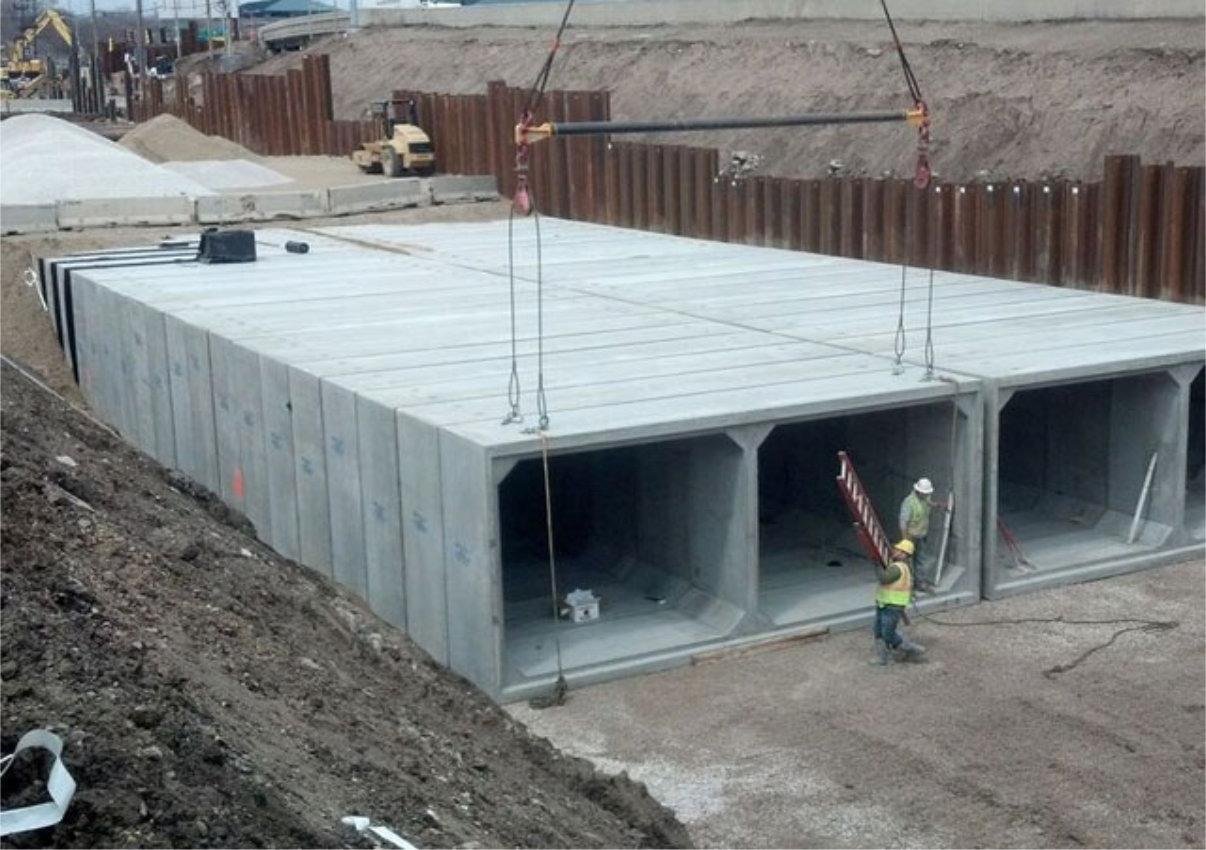
Precast concrete box culverts are made in one of two ways. Dry cast uses zero-slump concrete that is compacted between a core and an outer jacket by intense vibration and top pressing, then stripped immediately, so one mould set produces many units per shift. Wet cast places workable or self-consolidating concrete in a vibrated mould and leaves it to harden before stripping — fewer units per mould, but more freedom in shape, finish and openings.
Which standards govern precast box culverts?
Box culverts are designed and accepted against a product standard, and that standard is usually indifferent to the casting method. ASTM C1577 covers single-cell box sections cast monolithically for culverts, storm drains and sewers, designed to AASHTO LRFD. In Europe, EN 14844 covers monolithic rectangular box culverts and treats units with internal width and height up to 1,250 mm as small (non-structural or light structural) elements; larger units are structural.
Several highway authorities state explicitly that either method is acceptable. North Carolina DOT’s special provision for optional precast box culverts allows manufacture by wet cast or dry cast, and does not require air entrainment for dry cast production. A draft Indian standard for precast box culverts goes further and classifies units by casting method itself: dry cast (machine made) and wet cast.
Joints are part of the product. Box sections are normally produced with tongue-and-groove ends, sealed with preformed butyl rubber sealant (ASTM C990) or external wrap (ASTM C877). Joint geometry is where the two production methods differ most in practice, as explained below.
How does dry cast box culvert production work?
Dry cast production compacts a stiff, zero-slump mix inside a steel mould by external vibration, often combined with a pressing head, and removes the mould immediately.
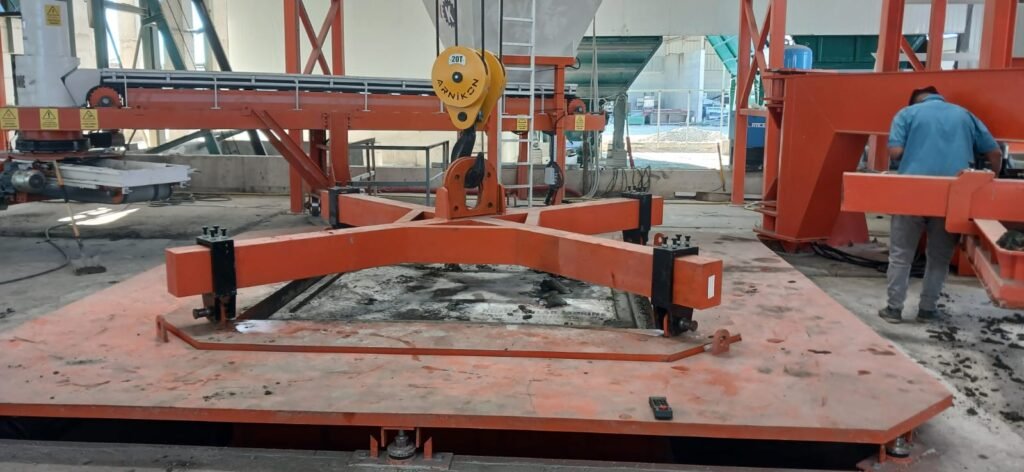
The mould has four main parts:
- Pallet (bottom ring): a steel ring that forms one joint end (tongue or groove) and carries the green unit to the curing area.
- Core: forms the inner faces of the box.
- Jacket (outer form): forms the outer faces.
- Header / top press: slides between core and jacket to compact the last layer and form the opposite joint end.
A typical cycle runs as follows:
- The reinforcement cage is placed on a clean, oiled pallet.
- Core, jacket and pallet are assembled into a closed cavity.
- Concrete is fed in layers while vibrators run. Vibration can be applied through the jacket or through vibrators built into the core.
- The header or top press compacts the final layer and shapes the top joint.
- The mould is lifted; the green unit stays standing on its pallet.
- The pallet with the unit is moved to curing, and a new pallet goes under the mould.
Two production layouts are common. In form-strip production, the core stays in place and the jacket and pallet are moved together to the curing area. In egg-laying production, the product stays where it was cast and the mould moves to the next position. Patent literature on modular box culvert moulds describes both arrangements, and both can be run with dry cast or wet cast concrete.
Engineering details that buyers should understand:
- Taper. Because the jacket and core are pulled off fresh concrete, walls need a slight taper to break skin friction and suction. The National Precast Concrete Association (NPCA) gives a typical value of 1/8 to 1/4 inch (about 3–6 mm) over the wall length.
- Vibration tuning. NPCA notes that vibration settings must suit the product: small units respond to high frequency and low amplitude, tall heavy sections to higher amplitude and lower frequency. Frequency control (usually via an inverter) is therefore a real specification item, not an option.
- Mould stiffness. A dry cast mould must be rigid enough to transmit vibration energy, yet not so heavy that the extra mass absorbs it. Simply adding thicker plate or stiffeners can reduce compaction.
- Air entrainment. Controlled air content is practically impossible in dry cast concrete because intense vibration collapses the bubbles. NPCA reports that properly made dry cast pipe and box culverts have still shown good freeze-thaw resistance.
How does wet cast box culvert production work?
Wet cast production fills a closed mould with conventional workable concrete or self-consolidating concrete (SCC), consolidates it, and leaves the unit in the mould until it is strong enough to strip. Units are usually cast on end, using an inner core and an outer form, as in dry cast — but the mould is designed to open rather than lift off.
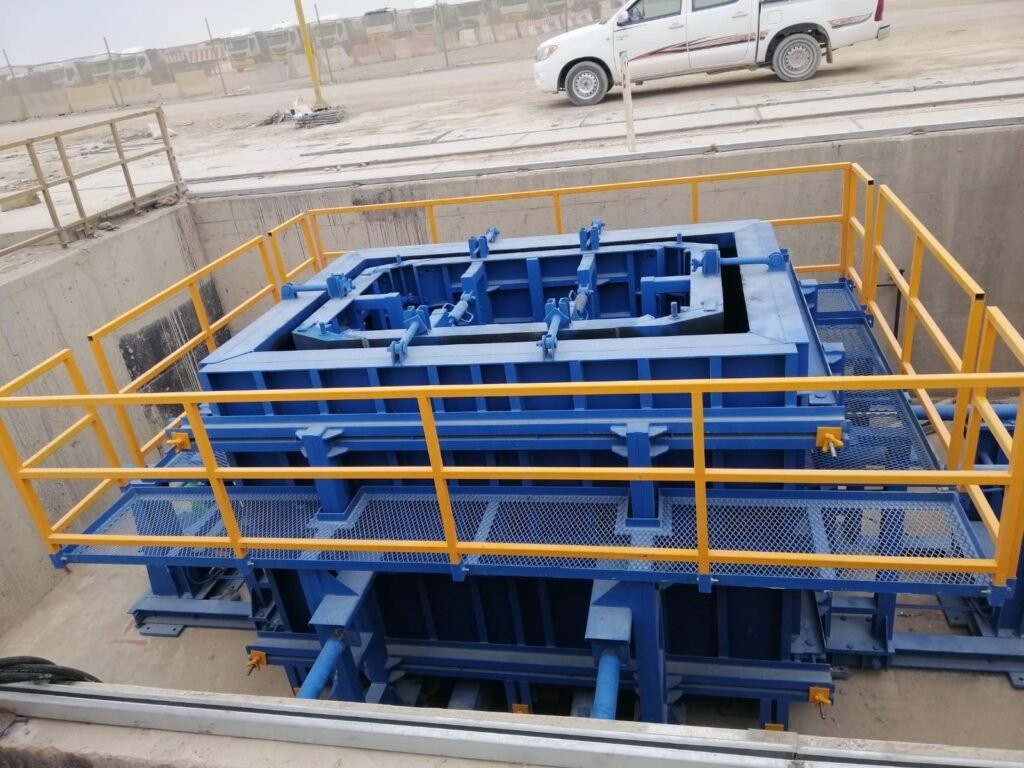
- Outer form: hinged or split panels that open away from the hardened unit.
- Collapsible core: retracted mechanically or by hydraulic cylinders so it releases the inner faces without dragging. This removes the need for wall taper.
- Vibration: external form vibrators clamped to the mould, internal poker vibrators, or both. With SCC, vibration is minimal or not needed.
- Blockouts and hole formers: fixed to the mould before casting, which makes side openings, lifting recesses and inserts straightforward.
The trade-off is time. A conventional wet cast mould delivers roughly one unit per curing cycle, typically overnight. The unit is stripped once it reaches the handling strength defined in the plant’s quality plan.
To shorten the cycle, plants use accelerated (steam or heat) curing. Industry guidance sets clear limits:
| Curing phase | Typical guidance | Source |
|---|---|---|
| Preset (before heating) | 3–5 hours is normal for precast | PCI Journal (2012) |
| Temperature rise | 10–20 °C per hour | CPCI curing guide |
| Holding temperature | 60–70 °C; PCI proposes a 65 °C maximum for precast products | CPCI, PCI Journal |
| Cooling | Gradual, before handling or moving outdoors | CPCI |
The upper temperature limit exists mainly to avoid delayed ettringite formation (DEF), a form of internal sulfate attack that can damage concrete years after production.
How do dry cast and wet cast concrete mixes differ?
The two methods use different concretes, and the difference drives almost everything else in the plant.
| Property | Dry cast | Wet cast |
|---|---|---|
| Consistency | Zero slump (stiff, earth-moist) | Plastic to flowable; SCC possible |
| Water-cement ratio | About 0.30–0.38 (NPCA) | Set by mix design; some specifications cap it (e.g. ≤ 0.40 in the Indian draft standard) |
| Compaction | Intense external vibration ± pressing | Form or poker vibration; little or none with SCC |
| Aggregate | Crushed aggregate preferred for green stability | Wider choice; grading tuned to workability |
| Air entrainment | Not practical; often not required by specifications | Possible and often specified for freeze-thaw exposure |
| Fresh testing | Slump and air tests not meaningful | Slump/flow and air tests standard |
| Strength test specimens | Cylinders made by special compaction methods | Standard cylinder or cube procedures |
| Early strength | High; in some cases specified strength in 24 hours (NPCA) | Depends on mix and curing regime |
Because dry cast concrete cannot be tested with a slump cone, mix control relies on moisture measurement of aggregates, consistent batching and the behaviour of the green product itself. A unit that slumps or cracks after stripping is the first warning sign.
How do output, investment, finish and geometry compare?
Dry cast wins on output per mould; wet cast wins on flexibility and surface quality.
| Factor | Dry cast (machine, vibro-press) | Wet cast (vibrated mould) |
|---|---|---|
| Units per mould set | Many per shift; one mould serves many pallets | About one per mould per curing cycle |
| Equipment | Machine or vibration station, heavy-duty mould, pallets, handling | Moulds, vibrators, crane; curing enclosure |
| Investment logic | High fixed cost, low cost per unit at volume | Lower entry cost; output scales by adding moulds |
| Size changes | Modular moulds with extensions; each size is a mould investment | Easier to add special sizes |
| Wall geometry | Slight taper needed; tall, thin walls are harder | Vertical walls; thin walls feasible |
| Openings | Large openings risk wall collapse; often added by coring or temporary fillers | Easily formed with blockouts |
| Surface | Can appear textured | Smooth, dense formed surface |
| Hydraulic roughness (Manning’s n) | Typical 0.015 | Typical 0.012 |
| Typical use | Standard storm drainage and road culverts in volume | Sanitary/wastewater, special shapes, large or custom units |
Two points are often overlooked. First, hydraulics: the slightly rougher dry cast surface means a higher Manning’s n, which the designer should use when sizing the opening. Second, output depends on curing capacity, not just casting speed — a fast dry cast machine needs enough pallets and curing space to keep up.
What quality checks matter for each method?
Both methods must produce sound, dimensionally accurate units with correct cover and well-formed joints. The emphasis differs.
Common checks
- Dimensions against the product standard or contract (the Indian draft, for example, sets ±5 mm on length, breadth and thickness).
- Concrete cover to reinforcement (minimum 25 mm in the Indian draft; ASTM and EN tables apply where specified).
- Compressive strength from test specimens and, where specified, load tests.
- Freedom from structural cracks and honeycombing.
- Joint dry-fit: several specifications require sections to be fitted together in the plant to confirm joint consistency. A regional ACPA guide specification sets different dry-fit test frequencies for wet cast and dry cast sections.
Dry cast specifics
- Moisture control of aggregates and mix, batch by batch.
- Pallet condition: a worn or dented pallet produces a poor joint on every unit it carries.
- Vibrator condition and frequency settings per product size.
- Green-state inspection right after stripping (slumping, top cracking over the cage).
Wet cast specifics
- Mould cleaning and release agent after every use.
- Cage fixing so reinforcement does not move during placing and vibration.
- Curing temperature records, especially with steam or heat curing.
Which method fits your project or market?
Choose dry cast if your market buys a limited range of standard sizes in large quantities; choose wet cast if you need many sizes, special shapes or sanitary-grade surfaces. NPCA’s own guidance is that the cost of dry cast forms and equipment is justified when the market is large and the product can be standardised.
Questions to answer before choosing:
- Volume: how many units per day, and for how many years of steady demand?
- Size range: how many different spans and rises will you produce? Each size means mould parts in either method.
- Product type: stormwater road culverts, or sewer and wastewater structures?
- Specials: side openings, skews, multi-cell units, very large sections?
- Curing: do you have the space, water and energy for a curing area that matches casting speed?
- Labour: dry cast needs a skilled machine operator and disciplined mix control; wet cast needs more crane and mould-handling work per unit.
Many established plants run both: dry cast for the standard sizes that make up most volume, and a few wet cast moulds for specials and small orders.
What this means for buyers in Africa and the Middle East
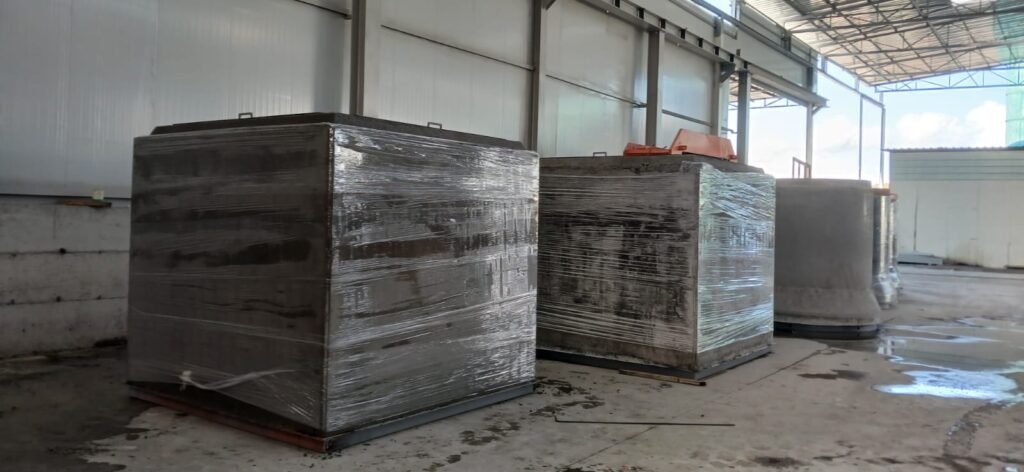
In hot, dry climates, curing is the critical step for both methods. A freshly stripped dry cast unit has a large exposed surface and very little water to spare, so it must go straight into a covered, humid curing area or under tarps with moisture. For wet cast production, high ambient temperatures add to the heat of hydration; ACI 305 (hot weather concreting) and the accelerated-curing temperature limits above become more important, not less.
Other practical points for these markets:
- Aggregate supply: dry cast performs best with consistent, crushed aggregate. Check local quarry output and grading stability before committing to the method.
- Power supply: vibrators, inverters and hydraulics need stable power; plan for a generator or stabilisation where the grid is weak.
- Wear and spare parts: vibrator bearings, pallets and mould wear surfaces are consumables. Plan a spare parts list with the equipment order.
- Tender specifications: many public tenders reference ASTM, EN or national standards. Confirm which standard and which joint type the client specifies before choosing the method and mould design.
How VDA can help
VDA works with a network of 300+ Turkish manufacturers and helps buyers define the right box culvert production setup — dry cast, wet cast or both — for their sizes, volumes and market. We clarify the technical scope, compare manufacturer offers and coordinate until delivery. Send your size range and target output through our request for quotation form or message us on WhatsApp at +90 543 797 58 57.
Related: Concrete pipe and culvert machines · Precast moulds · Concrete pipes and concrete pipe making machines
Sources
- ASTM International — ASTM C1577, Precast Reinforced Concrete Monolithic Box Sections for Culverts, Storm Drains, and Sewers Designed According to AASHTO LRFD (current edition 2025).
- CEN — EN 14844:2006+A2:2011, Precast concrete products — Box culverts.
- ASTM International — ASTM C990/C990M-25, Joints for Concrete Pipe, Manholes, and Precast Box Sections Using Preformed Flexible Joint Sealants.
- North Carolina DOT — Project Special Provision PSPD028, Optional Precast Reinforced Concrete Box Culvert (2024).
- Bureau of Indian Standards — Draft Indian Standard, Precast Concrete Box Culvert and U Drain Specification (2024).
- National Precast Concrete Association — “Top 10 Facts about Dry-Cast Concrete” (E. Carleton, P.E.).
- American Concrete Pipe Association — Precast Concrete Box Culverts presentation (manufacturing methods, Manning’s n, joints).
- Mountain States Concrete Pipe Association (ACPA region) — Precast Concrete Box Culvert and Three-Sided Structure Guide Specification (2017).
- Canadian Precast/Prestressed Concrete Institute — Curing of High Performance Precast Concrete.
- PCI Journal (Summer 2012) — Optimization of steam-curing regime for high-strength self-consolidating concrete.
- CPI – Concrete Plant International — “Vibration technology compared with wet cast production in static molds” (2023).
- US Patent 9,194,096 — System and method for constructing modular concrete ducts (form-strip and egg-laying production).
Frequently asked questions
Is dry cast box culvert concrete weaker than wet cast?
No. Dry cast concrete has a low water-cement ratio and high density, and can reach specified strength early. Both methods are accepted under the same product standards when the units pass the required tests.
Why do dry cast box culverts have a slight taper?
The mould is lifted straight off the fresh concrete, so a small taper — typically 3–6 mm over the wall length — reduces friction and suction during stripping.
Can one mould produce several box culvert sizes?
Modular moulds can be adjusted with extensions to the core, jacket, pallet and header, but each size still needs its own set of parts. Plan the size range before ordering.
Which method is better for sewer and wastewater box culverts?
Wet cast is commonly used for sanitary applications because it gives a smoother, denser surface and easier formation of openings, though dry cast units are also used where specifications allow.
How long does a wet cast box culvert stay in the mould?
Typically until the next working day under conventional curing. Accelerated curing shortens this, within temperature limits set by industry guidance.