Key takeaways
- Choose the concrete first, then the mixer, then the plant layout. A plant that makes C30 ready-mix well may not make good dry-cast pipes or self-compacting precast.
- Wet (central-mix) plants give the most consistent concrete. Dry (transit-mix) plants rely on the truck drum to mix and need more trucks in good condition.
- Rated capacity (m³/h) is batch volume times the number of cycles per hour. Real output is lower, so ask for the cycle time with your mix.
- EN 206 sets batching tolerances of ±3% for cement, water and aggregates and ±5% for admixtures. Weighing equipment must be able to hold these.
- In hot climates, aggregate temperature drives fresh concrete temperature. Shading, chilled water and ice are plant options, not site improvisations.
- Match mixer wear parts and spare stock to the plant from day one. Liners and paddles are consumables.
A concrete batching plant weighs cement, aggregates, water and admixtures to a recipe and either mixes them in its own mixer (wet or central-mix plant) or loads them into a truck mixer (dry or transit-mix plant). The right plant depends on the concrete you make: twin-shaft mixers suit ready-mix and road work, planetary and pan mixers suit precast, and continuous pugmills suit RCC and soil stabilisation.
What does a concrete batching plant do?
A batching plant measures each ingredient by weight (or by volume for some liquids), combines them in a set sequence and discharges concrete or a dry batch for delivery. The US Environmental Protection Agency’s description of the industry lists the same basic flow for all plants: raw materials are received and stored, cement is transferred to silos, ingredients are weighed, then mixed in a central mixer or loaded into truck mixers.
The plant does not decide the concrete’s quality on its own. The mix design does. What the plant controls is how accurately and how repeatably it follows that design, batch after batch. That is why weighing accuracy, moisture correction and the mixer are the parts buyers should look at hardest.
What are the main components of a batching plant?
Every plant has the same building blocks, whatever its size. The table shows what each part does and what to check in an offer.
| Component | What it does | What to check in an offer |
|---|---|---|
| Aggregate bins (bunker) | Store sand and stone by size; pneumatic gates dose each fraction | Number of compartments (one per aggregate size), volume per compartment, loading ramp or pre-feeding system |
| Aggregate weighing (belt or skip) | Weighs aggregates and carries them to the mixer | Weighing capacity per batch, load cells, belt width and drive power |
| Cement silos and screw conveyors | Store cement and other binders; feed the cement scale | Number of silos (one per binder type), tonnage, dust filter, safety valve, level indicators |
| Cement, water and admixture scales | Weigh each ingredient separately | Scale capacity and load cells; separate admixture scale for each admixture |
| Mixer | Mixes the batch to a uniform concrete | Type, wet concrete volume per batch, motor power, liner and paddle material |
| Control system | Runs recipes, records each batch, prints delivery reports | PLC with recipe storage, batch records, manual override, moisture correction |
| Air compressor | Operates gates and discharge doors | Tank volume and pressure |
| Water system | Supplies and meters mixing water | Flowmeter or water scale, pump capacity, chiller or ice option in hot regions |
Two items are often missing from cheaper offers: moisture probes for sand and a separate silo for each cement or addition. Without moisture correction, the plant adds the same water whatever the sand’s moisture, and the water-cement ratio drifts.
Wet mix or dry mix: what is the difference?
A wet mix (central-mix) plant mixes all ingredients, including water, in a stationary mixer at the plant and discharges finished concrete into a truck mixer. A dry mix (transit-mix) plant weighs the dry materials and discharges them into the truck, where water is added and the drum does the mixing. EPA also describes a third route, shrink-mixing, where concrete is partly mixed at the plant and completed in the truck.
| Wet mix (central-mix) | Dry mix (transit-mix) | |
|---|---|---|
| Where mixing happens | Stationary mixer at the plant | Truck mixer drum |
| Consistency batch to batch | Highest; every batch goes through the same mixer | Depends on each truck, its blades and the driver |
| Best for | Precast, high-strength, SCC, quality-critical structures, high hourly output | Ready-mix fleets with long or variable haul distances |
| Main wear item | Plant mixer liners and paddles | Truck drums and blades |
| Note | Truck drum only agitates during transport | ASTM C94 calls for 70 to 100 revolutions at mixing speed to mix a load |
The American Concrete Institute notes that truck mixers should mix adequately in 70 to 100 revolutions at a mixing speed of roughly 12 to 18 rpm. For most buyers in Africa and the Middle East who build a new plant for a project, precast yard or local ready-mix business, the wet mix plant is the safer default.
Which mixer should you choose for your concrete?
Choose the mixer by the concrete you will make most of the time. The mixer is the most expensive single component and the hardest to change later.
| Mixer type | How it mixes | Best for | Watch out for |
|---|---|---|---|
| Twin-shaft | Two horizontal shafts with paddles turn in opposite directions; short, intense mixing | Ready-mix, high-strength concrete, RCC, large infrastructure; the most common choice for high output | Higher price and power; liners and paddles wear with abrasive aggregate |
| Single-shaft | One horizontal shaft with paddles | Medium output plants with limited space | Less mixing intensity than twin-shaft at the same volume |
| Planetary | Mixing stars rotate on their own axis while orbiting the pan; no dead zones | Precast, self-compacting concrete (SCC), coloured and architectural concrete, fibre concrete | Smaller batch volumes; higher cost per m³ of capacity |
| Pan (turbine) | Blades rotate around a central vertical shaft in a fixed pan | Blocks, pavers, pipes, small precast, mortar | Less intense than planetary; slower for stiff mixes |
| Tilting or reversing drum | Free-fall mixing in a rotating drum | Simple, low-cost plants and standard mixes | Longer mixing time; less suited to stiff or high-performance mixes |
| Continuous pugmill (twin-shaft) | Material is mixed while it moves through the mixer | RCC, cement-treated base, soil stabilisation, cold recycling | Volumetric dosing; batch plants remain the choice for very tight recipes |
Mixing time matters as much as mixer type. A common rule for stationary mixers is at least one minute for the first cubic yard (0.76 m³) of capacity plus 15 seconds for each additional cubic yard, adjusted by mixer performance tests. Mixing too long is also harmful: it can heat the mix, grind soft aggregates and reduce workability.
Which types of concrete can a batching plant produce?
Most plants make normal structural concrete. Special concretes need specific mixer types and plant options, so list every product you plan to make before asking for offers.
| Concrete type | Typical use | What the plant needs |
|---|---|---|
| Normal structural concrete (EN 206 classes such as C20/25 to C40/50) | Buildings, foundations, slabs, general civil works | Any well-maintained wet or dry plant; accurate weighing |
| High-strength concrete (C50/60 and above) | High-rise columns, bridges, prestressed elements | Twin-shaft or planetary mixer; extra silo for silica fume or other additions; precise admixture dosing |
| Self-compacting concrete (SCC) | Precast, congested reinforcement, architectural finishes | Planetary or twin-shaft mixer; moisture probes; tight water control |
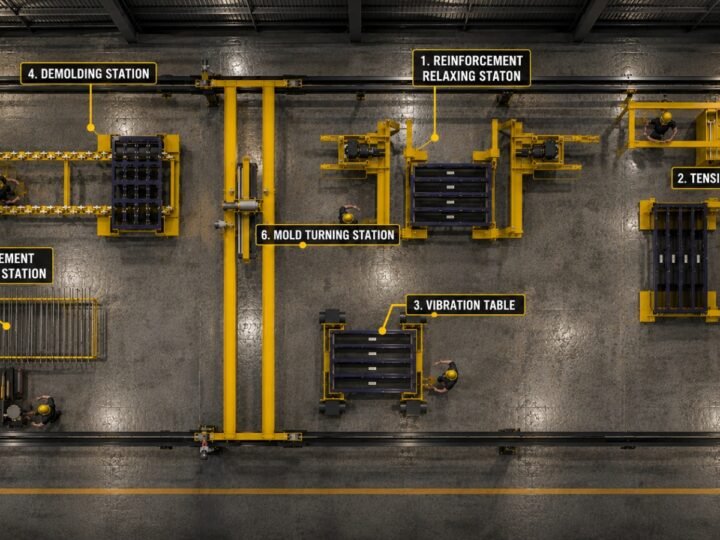
| Earth-moist (dry-cast) concrete | Concrete pipes, blocks and pavers, dry-cast box culverts | Pan or planetary mixer close to the forming machine; very stable sand moisture |
| Roller-compacted concrete (RCC) | Dams, heavy-duty pavements, port and mine yards | High-capacity twin-shaft batch mixer or continuous pugmill; large aggregate feed |
| Cement-treated base and stabilised soil | Road bases | Volumetric continuous plant or pugmill |
| Mass concrete | Thick foundations, dam blocks | Temperature control: chilled water, ice, low-heat binders |
| Fibre-reinforced concrete | Industrial floors, shotcrete, precast | Fibre dosing system; EN 206 sets batching tolerances of ±3% for fibres used at more than 5% of cement mass and ±5% below that |
EN 206 groups concrete by compressive strength class, from C8/10 to C100/115 for normal-weight concrete, and by exposure class: X0 (no risk), XC (carbonation), XD (chlorides other than seawater), XS (seawater chlorides), XF (freeze-thaw) and XA (chemical attack). Your project specification uses these classes. Give them to the manufacturer, because they decide binder types, number of silos and admixture lines.
Stationary, mobile, compact or volumetric: which plant format fits?
The plant format follows how long you stay on one site and how much you produce. A stationary plant suits a permanent ready-mix or precast operation. A mobile plant on its own chassis suits contractors who move between projects. A compact containerised plant ships in standard containers and needs lighter foundations. A volumetric continuous plant suits road bases and remote sites with mixed products.
| Format | Typical use | Strength | Limitation |
|---|---|---|---|
| Stationary | Ready-mix company, precast factory, multi-year project | Highest output and storage; widest choice of mixers | Foundations and longer erection |
| Mobile | Road, rail and dam contractors moving between sites | Faster relocation | Smaller storage; output usually lower |
| Compact containerised | Remote sites, export by container | Easy shipping, light foundations | Limited bin and silo volume |
| Volumetric continuous | Road bases, stabilisation, mixed products | Little foundation work, low installed power | Volumetric dosing; not for very tight recipes |
How do you read the rated capacity (m³/h)?
Rated capacity is the theoretical output: wet concrete volume per batch multiplied by the number of batches the plant can complete in an hour. Two real plant specifications from manufacturer documents on file at VDA show how this works.
| Item | Mobile plant | Stationary plant |
|---|---|---|
| Rated capacity | 70 m³/h | 140 m³/h |
| Mixer | Pan mixer, 1.3 m³ wet concrete per batch, 45 kW | Twin-shaft mixer, 4 m³ wet concrete per batch, 2 × 75 kW |
| Aggregate bins | 3 × 15 m³ (45 m³) | 4 × 30 m³ (120 m³) |
| Cement storage | 1 × 100 t silo | 2 × 100 t silos, plus 15 t admixture silo |
| Cement scale | 850 kg | 2,500 kg |
| Water scale | 600 kg | 1,500 kg |
| Implied batches per hour | about 54 (70 ÷ 1.3) | 35 (140 ÷ 4) |
| Implied cycle time | about 67 seconds | about 103 seconds |
The implied cycle time includes weighing, charging, mixing and discharge. If your mix needs longer mixing, for example SCC or fibre concrete, the cycle gets longer and hourly output drops. Truck changeovers, aggregate loading and recipe changes also reduce real output. Ask each manufacturer for the cycle time with your mix design, not only the catalogue figure.
How many truck mixers does a plant need?
The number of trucks depends on haul time, not only on plant size. Divide the truck round trip by the time the plant takes to fill one truck. Truck mixers typically carry 5 to 9 m³, according to the US National Ready Mixed Concrete Association.
Example (illustration only): a plant producing 60 m³/h in practice fills an 8 m³ truck in 8 minutes. If loading, a 20-minute drive, 15 minutes on site and a 20-minute return give a round trip of about 63 minutes, you need about 63 ÷ 8 ≈ 8 trucks to keep the plant running. Double the drive time and the fleet nearly doubles.
Keep within the discharge time your specification allows. ASTM C94 limits discharge to 90 minutes or 300 drum revolutions after water is added. Hot weather shortens the practical window.
How accurate must batching be?
EN 206 sets tolerances per load of 1 m³ or more: ±3% for cement, water, total aggregates and additions used at more than 5% of cement mass, and ±5% for admixtures. The European Ready Mixed Concrete Organization (ERMCO) shows that these limits keep the worst-case rise in water-cement ratio to about 0.04.
US-specified projects using ASTM C94 apply tighter values for most batch sizes, such as ±1% for cement, ±2% for aggregates and ±3% for admixtures; since 2021, batch water must be within ±1.5% of target. If your project uses a stricter specification, tell the manufacturer, because it affects scale sizes and load cells.
What changes for a plant in a hot climate?
In hot climates, the plant must be able to produce concrete below the specified temperature limit. ACI 305.1 recommends a maximum of 35°C at discharge unless field experience supports a higher value, and Dubai Municipality’s ready-mix guide also caps placed concrete at 35°C. Your project specification may set a lower limit.
Aggregates control most of the result. A simplified formula used by cement producers estimates fresh concrete temperature as roughly 0.1 × cement temperature + 0.7 × aggregate temperature + 0.2 × water temperature. A hot silo matters far less than a stockpile in direct sun.
Plant options for hot regions:
- Shaded or covered aggregate bins and stockpiles, with sprinklers for evaporative cooling
- Water chiller and insulated water tank and pipes
- Ice plant and ice weighing: replacing all mixing water with ice can lower concrete temperature by about 8 to 11°C; ice must melt fully before the mixer discharges
- Light-coloured or insulated silos
- Retarding admixture line for long hauls
Adding water at site to cool or loosen an overheated load is not a fix. It raises the water-cement ratio and lowers strength.
What this means for buyers in Africa and the Middle East
- Specify the climate. Give the manufacturer your maximum summer temperature, required concrete temperature and haul times. Chilled water and ice must be priced into the first offer.
- Plan for dust. EPA’s emission factors cover cement unloading to silos, weigh hopper loading, mixer loading at central-mix plants and truck loading at transit-mix plants. Ask for silo filters and dust capture at the loading point, and check local permit rules.
- Check aggregate quality and moisture. Where sand moisture changes with the season or aggregates may carry salts, add moisture probes and test aggregates before you size bins.
- Budget for power. Note the plant’s installed power and whether you will run on grid or generator.
- Stock wear parts. Mixer liners, arms and paddles are consumables. Order a first set of spare and wear parts with the plant.
- Get the civil scope in writing. In the plant offers VDA reviews, the buyer usually provides foundations to the manufacturer’s drawings, the electrical supply and the water line, plus a crane for erection. Clarify this before you compare prices.
What drives the cost of a concrete batching plant?
Prices vary widely by manufacturer, capacity and options, so compare offers line by line (see our step-by-step guide to buying from a Turkish manufacturer). The main cost drivers are:
- Rated capacity and mixer type and size
- Number and volume of aggregate compartments; ramp or pre-feeding system
- Number and size of cement silos and screw conveyors
- Number of admixture lines and scales; moisture probes
- Control system, batch records and dispatch software
- Hot-climate options: chiller, ice plant, shading, insulation
- Dust collection
- Steel structure, foundations, transport (number of containers or flat racks) and erection supervision
- Spare parts package, training and warranty terms
How VDA can help
VDA Trade Cooperation sources stationary, mobile, compact and volumetric concrete batching plants from Turkish manufacturers for buyers in Africa and the Middle East. Send us the concrete you will produce, target output, haul distances and site climate, and we will compare suitable offers with you. Browse our concrete batching plant range or request a quote. You can also message us on WhatsApp at +90 543 797 58 57.
Sources
- US EPA, AP-42 Section 11.12: Concrete Batching (June 2006) and background document
- American Concrete Institute, FAQ: What factors affect the mixing time?
- JoVE Core Civil Engineering, Mixing time
- Buildwise, Specification of concrete to NBN EN 206 (strength classes C8/10 to C100/115)
- CIDB Malaysia, CIS 21 draft (reproduces EN 206 batching tolerances, including fibres)
- ACI Committee 207, Report on Roller-Compacted Mass Concrete (ACI 207.5R-11)
- ERMCO, Guide to EN 206:2013 (batching tolerances, Table 3 and Annex A)
- NRMCA, CIP 31: Ordering Ready Mixed Concrete and CIP 12: Hot Weather Concreting
- US NRC, Batching, Mixing and Transporting Concrete: ASTM C94 tolerances; Concrete Products, ASTM C09 revises C94 batch water accuracy target
- Pavement Interactive, PCC Truck Mixer
- Giatec Scientific, What’s the ideal temperature to pour concrete? (ACI 305.1, ASTM C94 and EN 206 limits; ice cooling)
- Dubai Municipality, TG-02:2024 Technical Guide for the Operation of Ready Mixed Concrete Plants
- Holcim (Switzerland), Pocket guide: concreting in cold weather (fresh concrete temperature formula)
- Manufacturer technical data for mobile and stationary batching plants (Türkiye), on file at VDA
Frequently asked questions
What is the difference between a batching plant and a concrete mixer?
A batching plant weighs and stores the ingredients and controls the recipe. The mixer is one component inside it, or the truck drum in a dry mix plant.
Which mixer is best for ready-mix concrete?
Twin-shaft mixers are the most common choice for high-output ready-mix because they mix fast and handle a wide range of mixes. Planetary mixers are preferred when precast quality, SCC or coloured concrete is the main product.
Can one plant make both ready-mix and precast concrete?
Yes, if the mixer and controls suit the most demanding product. Plants serving dry-cast pipe or block machines often need a separate pan or planetary mixer next to the machine.
Is a 60 m³/h plant enough for my project?
Work back from your largest daily pour and allow for real output below the rated figure. Then check that you have enough truck mixers for your haul time.
What do you need from me for a quote?
The concrete types and strength classes, daily volume, number of aggregate sizes and binders, site climate, power source and delivery country.