
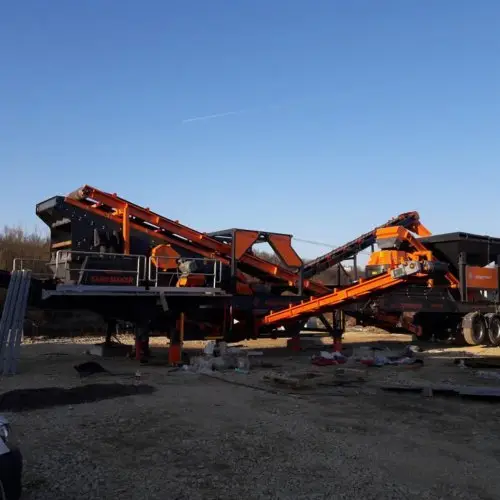
Mobile crushing & screening plant
Tracked and wheeled crushing and screening units from about 50 to 500 tph per train. They move with the quarry face, follow a road project or relocate between sites, with little civil work.
- Capacity
- About 50 to 500 tph per train
- Chassis
- Tracked or wheeled
- Power
- Diesel-hydraulic or diesel-electric
- Typical use
- Quarries, road projects, recycling
- Civil works
- Minimal
Indicative figures based on manufacturer data. Capacity and specification are confirmed in each offer.
What a mobile crushing plant does
A mobile crushing and screening plant puts the feeder, crusher, screen and conveyors on transportable units. Each unit carries its own power pack, so the plant can start producing soon after it arrives on site, without foundations, buildings or long cable runs. Units are combined into a train: for example a jaw crusher unit feeding a cone crusher unit and a screening unit.
Tracked or wheeled
- Tracked units move on their own crawler tracks and can follow the work face inside a quarry. They are transported between sites on a lowbed trailer.
- Wheeled (portable) units are mounted on a semi-trailer chassis and towed between sites by road. They suit contractors who relocate often over longer distances.
Where mobile plants make sense
- Road and rail projects that need base course or ballast along the route.
- New quarries where the deposit is still being proven.
- Contract crushing for several clients and sites.
- Demolition and recycling, turning concrete and asphalt waste into recycled aggregate.
- Remote mining sites where civil works are slow or costly.
Mobile or stationary?
For the same capacity, mobile units usually cost more to buy and run at a higher cost per tonne, mainly because of diesel power and wear from relocation. They save months of civil work and keep the investment movable. A stationary crushing and screening plant is often the better choice for a long-life deposit with steady demand. Some mobile units can also be connected to grid power when it is available.
What the offer covers
We ask the manufacturers for the same scope so offers compare line by line: unit configuration and expected product split, crusher and screen sizes, engine or power-pack details, transport dimensions and weights, standard and optional equipment such as magnets and side conveyors, commissioning and operator training, and a recommended spare parts list.
Equipment pages
Typical data for the machines used in mobile trains: jaw crushers, impact crushers, screens, tracked conveyors and stackers and the portable sand making and washing plant.
How the line works
Feeding
A vibrating feeder with pre-screen delivers material to the crusher and removes soil and fines.
Primary crushing
A mobile jaw crusher unit, or an impact unit for softer rock and recycling, makes the first reduction.
Secondary crushing
A mobile cone crusher unit reduces hard rock to finer, cubical products.
Screening
A mobile screening unit splits the material into fractions. Oversize can return to the crusher in a closed circuit.
Stockpiling
Side conveyors on each unit build separate product stockpiles.
Relocation
Units fold for transport and move to the next work face or site.
Main machines and systems
Mobile jaw crusher unit
Primary crushing of quarry rock and large feed.
Mobile cone crusher unit
Secondary and tertiary crushing of hard, abrasive rock.
Mobile impact crusher unit
Crushing of softer rock and recycling material, with good particle shape.
Mobile screening unit
Two- or three-deck screen for separating final products.
Feeder and pre-screen
Even feed to the crusher and removal of fines before crushing.
Stockpile conveyors
Fold-out side conveyors for each product.
Power pack
Diesel engine with hydraulic or electric drive; grid connection is available on some units.
Magnet separator
Removes reinforcing steel from recycled concrete.
- Option for recycling
Output by size
Typical values from manufacturer documentation, per 8 hour shift. Final figures are confirmed in the manufacturer's offer for your project.
Typical mobile train by application
| Application | Typical units | Main products |
|---|---|---|
| Hard rock quarry | Jaw unit, cone unit, screen unit | Chips, base course |
| Limestone and soft rock | Impact unit, screen unit | Base course, chips |
| River gravel | Cone unit, screen unit, optional washing | Sand, chips |
| Road project | Jaw unit, screen unit | Base course, sub-base |
| Demolition recycling | Impact unit with magnet, screen unit | Recycled aggregate |
A guide only. The final train depends on your material, feed size and capacity.
Wheeled portable plant configurations
| Configuration | Main use |
|---|---|
| Portable jaw crusher | Primary rock reduction at the job site |
| Portable primary impact crusher | Demolition waste and soft stone |
| Portable screening unit | Screening aggregate at remote sites |
| Portable tertiary impact crusher | Sand for concrete from soft stone |
| Tertiary impact crusher with screen | Sand production with integrated screening |
| Compact crush-and-screen unit | Crushing and screening where space is tight |
| Crush-and-wash unit | Crushing and washing in one operation |
| Single-chassis cone plant | Hard stone on one chassis |
| Portable cone crusher | Secondary crushing of hard rock |
| Cone crusher with screen | Cone crushing with integrated screening |
| Portable VSI | Sand from hard stone or river gravel |
| Portable VSI with washing | Washed manufactured sand |
| Portable wobbler feeder | Feeding sticky, wet or muddy material |
Units are combined into a plant to match your material and products.
Specifications
Typical values from manufacturer documentation. Final figures are confirmed in the manufacturer's offer for your project.
| Capacity range | About 50 to 500 tph per train |
|---|---|
| Chassis | Tracked or wheeled semi-trailer |
| Crusher types | Jaw, cone, impact |
| Screens | 2- or 3-deck mobile screens |
| Drive | Diesel-hydraulic or diesel-electric |
| Grid connection | Available on some units |
| Typical products | Base course, chips, sand, recycled aggregate |
| Options | Magnet separator, extra side conveyors, dust suppression |
| Transport | Lowbed trailer (tracked) or towed (wheeled) |
Typical values. Unit sizes, engine power and capacity are confirmed in the manufacturer's offer for your material and products.
Built for these buyers
Road and rail contractors
Producing base course and ballast along the route.
Quarry start-ups
Opening a deposit before investing in a stationary plant.
Contract crushing companies
Serving several clients and sites with one fleet.
Demolition and recycling firms
Turning concrete and asphalt waste into recycled aggregate.
Mining companies
Crushing at remote or temporary sites.
Questions buyers ask
What information do you need to prepare an offer?
Material type, maximum feed size, required capacity in tonnes per hour, the end products, how often the plant will move, and the delivery country or port.
Should I choose tracked or wheeled units?
Tracked units suit moving inside a quarry or site. Wheeled units suit frequent road transport between sites. Both are available for crushers and screens.
Can a mobile plant run on grid power?
Some units have a diesel-electric drive with a grid connection, which lowers fuel cost when grid power is available on site.
How many units do I need?
It depends on the products. One crusher with one screen can produce base course. Two crushing stages with a screen are usual for asphalt and concrete chips.
How long does delivery take?
It depends on the units and options. The manufacturer confirms production and delivery time in the offer.
Can you supply wear parts after delivery?
Yes. Through our Direct Supply line we supply jaw plates, cone liners, blow bars and screen meshes, with OEM-equivalent and alternative options.
Related machinery
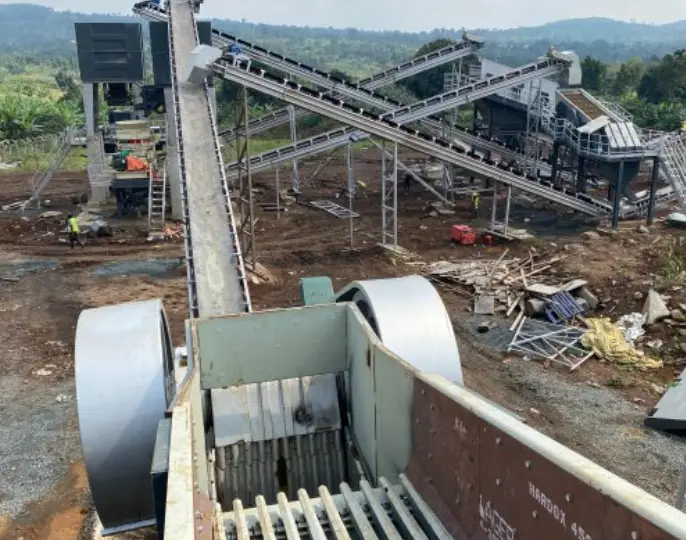
Stationary Crushing & Screening Plant
Fixed crushing and screening plants for quarries, mines and aggregate producers, from about 100 tph to over 1,000 tph. Two-, three- or…
View detailsConveyors, Tracked Conveyors & Radial Stackers
Belt conveyors, tracked stockpile conveyors and telescopic radial stackers that move and stockpile aggregate with less loader work.
View detailsPortable Sand Making & Washing Plant
Trailer-mounted plants that crush, screen and wash manufactured sand in one unit, from about 50 to 200 t/h.
View detailsRead before you buy
Get offers for Mobile Crushing & Screening Plant
- Tell us the product, capacity and project country.
- We clarify the technical scope with you.
- You receive offers from suitable manufacturers to compare.
- Prefer WhatsApp? +90 543 797 58 57