

Stationary crushing & screening plant
Fixed crushing and screening plants for quarries, mines and aggregate producers, from about 100 tph to over 1,000 tph. Two-, three- or four-stage lines are configured from your rock type, feed size and the products you need to sell.
- Capacity
- About 100 to over 1,000 tph
- Crushing stages
- 2, 3 or 4
- Typical products
- Sand, chips, base course, ballast
- Power
- Grid power
- Site
- Permanent, on foundations
Indicative figures based on manufacturer data. Capacity and specification are confirmed in each offer.
What a stationary crushing plant does
A stationary crushing and screening plant is installed on foundations or a steel structure at a permanent site. It reduces blasted rock or river gravel step by step and separates it into fractions for concrete, asphalt, road base and railway ballast. Because the plant stays in one place for years, it is designed around one deposit and one product mix, which keeps each stage working at its best load.
Configured from your rock and your products
No two quarries need the same plant. The configuration starts from a few facts:
- Rock type. Hardness and abrasiveness decide whether the secondary stage uses a cone crusher (hard, abrasive rock such as basalt and granite) or an impact crusher (softer rock such as limestone).
- Maximum feed size. The size of blasted rock or excavator feed sets the size of the feeder and the primary jaw crusher.
- Capacity and working hours. Tonnes per hour and shifts per day define the size of every crusher, screen and conveyor.
- End products. Typical fractions are 0-5 mm sand, 5-12, 12-22 and 22-32 mm chips, and 0-31.5 mm base course. Cubical chips for asphalt and manufactured sand need a tertiary stage.
- Site conditions. Grid power, water for washing, space for stockpiles and the climate all shape the layout.
Two, three or four crushing stages
Most plants combine a primary jaw crusher with one or two further stages and multi-deck screens. Oversize material returns to the crushers in a closed circuit until it passes the screens. A vertical shaft impactor (VSI) can be added for cubical chips and manufactured sand, and a sand washing and dewatering line can be added where clean sand is required.
Stationary or mobile?
A stationary plant suits a long-life deposit with steady demand. It runs on grid power and can be sized for high hourly output. A mobile crushing and screening plant suits projects that move, short-term contracts or sites where civil works are not practical. Many operators start mobile and add a stationary line once the deposit and the market are proven.
What the offer covers
For each project we ask the manufacturers for the same scope so offers can be compared line by line: flow sheet with expected product split, general layout, equipment list with motor powers, steel structures and chutes, conveyors, electrical panel and controls, foundation loads, installation and commissioning supervision, operator training and a recommended spare parts list.
Equipment for each stage
See typical sizes and data for each machine: feeders, jaw crushers, impact crushers, vertical shaft impactors, vibrating screens, conveyors and stackers and sand and aggregate washing equipment.
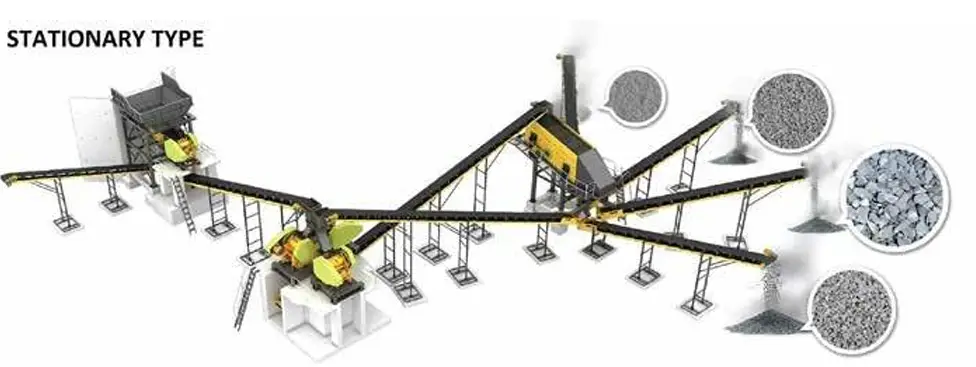
How the line works
Feeding and scalping
A vibrating grizzly feeder delivers an even flow to the primary crusher and removes soil and fines before crushing.
Primary crushing
The jaw crusher reduces blasted rock to a size the secondary stage can accept.
Secondary crushing
A cone crusher for hard rock or an impact crusher for softer rock reduces the material further.
Screening
Multi-deck vibrating screens split the material into fractions. Oversize returns to the crushers in a closed circuit.
Tertiary crushing and sand
A cone crusher or VSI shapes cubical chips and produces manufactured sand where the market needs them.
Washing and stockpiling
Optional sand washing removes fines and clay. Conveyors send each product to its own stockpile.
Typical plant components
Vibrating grizzly feeder
Feeds the primary crusher evenly and scalps out soil and fines.
Jaw crusher
Primary crushing of large feed material.
Cone crusher
Secondary and tertiary crushing of hard, abrasive rock to finer, cubical products.
Impact crusher
Secondary crushing of softer rock with good particle shape.
Vertical shaft impactor (VSI)
Tertiary stage for cubical chips and manufactured sand.
Vibrating screens
Two- to four-deck screens that separate the crushed material into the required fractions.
Conveyor belt systems
Move material between crushers, screens and stockpiles.
Sand washing and dewatering
Bucket-wheel or screw washers and dewatering screens for clean sand.
Electrical panel and controls
Central motor control panel with interlocks; PLC control is available.
Output by size
Typical values from manufacturer documentation, per 8 hour shift. Final figures are confirmed in the manufacturer's offer for your project.
Typical configuration by capacity
| Capacity | Stages | Typical line |
|---|---|---|
| 100 to 200 tph | 2 to 3 | Jaw crusher, cone or impact crusher, 3-deck screen |
| 200 to 400 tph | 3 | Jaw crusher, secondary cone, tertiary cone or VSI, 2 screens |
| 400 to 1,000+ tph | 3 to 4 | Large jaw crusher, secondary and tertiary cones, VSI, several screens |
A guide only. The final line comes from your rock data and the flow sheet.
Rock type and usual secondary crusher
| Rock | Abrasiveness | Usual secondary crusher |
|---|---|---|
| Limestone | Low | Impact crusher |
| Dolomite | Low to medium | Impact or cone crusher |
| River gravel | Medium to high | Cone crusher, VSI for sand |
| Granite | High | Cone crusher |
| Basalt | High | Cone crusher |
Rock tests from your deposit confirm the choice.
Specifications
Typical values from manufacturer documentation. Final figures are confirmed in the manufacturer's offer for your project.
| Capacity range | About 100 to over 1,000 tph |
|---|---|
| Crushing stages | 2, 3 or 4 |
| Primary crusher | Jaw crusher |
| Secondary crusher | Cone crusher or impact crusher |
| Tertiary / sand | Cone crusher or VSI (optional) |
| Screens | 2- to 4-deck vibrating screens |
| Typical products | 0-5, 5-12, 12-22, 22-32 mm; 0-31.5 mm base course |
| Washing | Optional sand washing and dewatering |
| Power supply | Grid, 400 V / 50 Hz or as specified |
| Controls | Central electrical panel, PLC optional |
| Installation | On concrete foundations or steel structure |
Typical values. Crusher sizes, motor powers and capacity are confirmed in the manufacturer's offer for your rock and product mix.
Built for these buyers
Quarry operators
Opening a new quarry or replacing an old, inefficient line.
Aggregate producers
Supplying ready-mix, precast and asphalt plants with graded aggregate and sand.
Road and rail contractors
Producing base course, asphalt chips and railway ballast for their own projects.
Mining companies
Crushing ore or waste rock at a permanent site.
Questions buyers ask
What information do you need to prepare an offer?
Rock type and any test data, maximum feed size, required capacity in tonnes per hour, working hours, the end products and their share, available power and water, and the delivery country or port.
Can one plant produce concrete aggregate, asphalt chips and ballast?
Yes, if the crushers and screens are configured for all the gradings you need. The product split is defined with the manufacturer at the flow-sheet stage.
How long do production and installation take?
It depends on the size and scope of the plant. The manufacturer confirms production time and installation time in the offer.
Who installs and commissions the plant?
Installation and commissioning are carried out by the manufacturer's team or under its supervision, together with your local civil and electrical contractors. The split of work is written into the offer.
Can you supply wear parts after delivery?
Yes. Through our Direct Supply line we supply jaw plates, cone mantles and concaves, blow bars and screen meshes, with OEM-equivalent and alternative options.
Should I choose a stationary or a mobile plant?
Stationary suits a long-life deposit with steady demand and grid power. Mobile suits sites that move or short contracts. Many operators combine both.
Related machinery
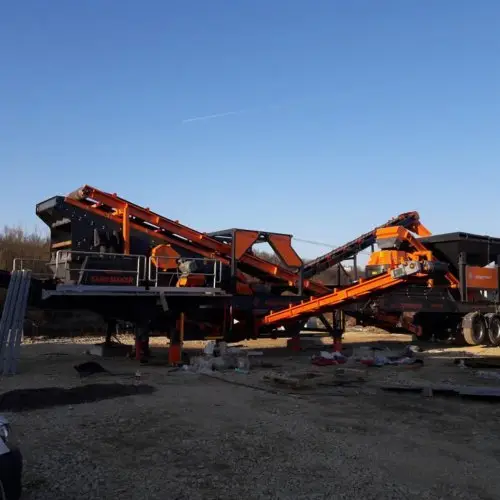
Mobile Crushing & Screening Plant
Tracked and wheeled crushing and screening units from about 50 to 500 tph per train. They move with the quarry face, follow…
View detailsJaw Crusher
Primary jaw crushers with feed openings from 610 × 380 to 1,400 × 1,100 mm and outputs from about 60 to over…
View detailsImpact Crushers: Primary, Secondary & Tertiary
Horizontal shaft impact crushers for primary, secondary and tertiary crushing of limestone, soft to medium rock and recycled material.
View detailsRead before you buy
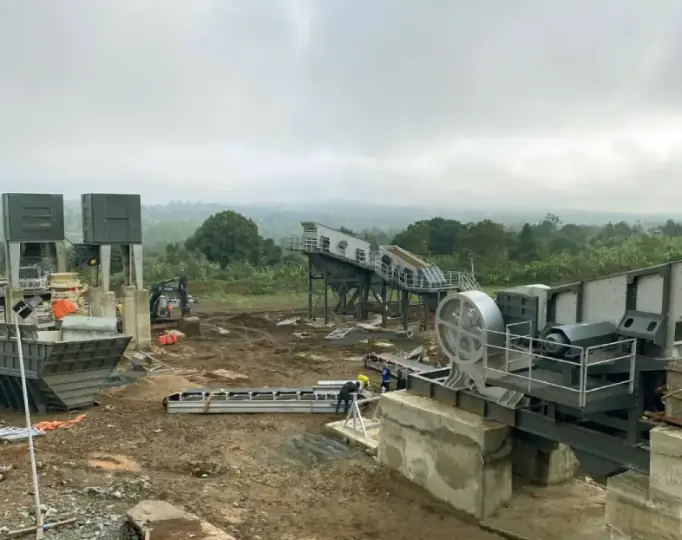
Get offers for Stationary Crushing & Screening Plant
- Tell us the product, capacity and project country.
- We clarify the technical scope with you.
- You receive offers from suitable manufacturers to compare.
- Prefer WhatsApp? +90 543 797 58 57